


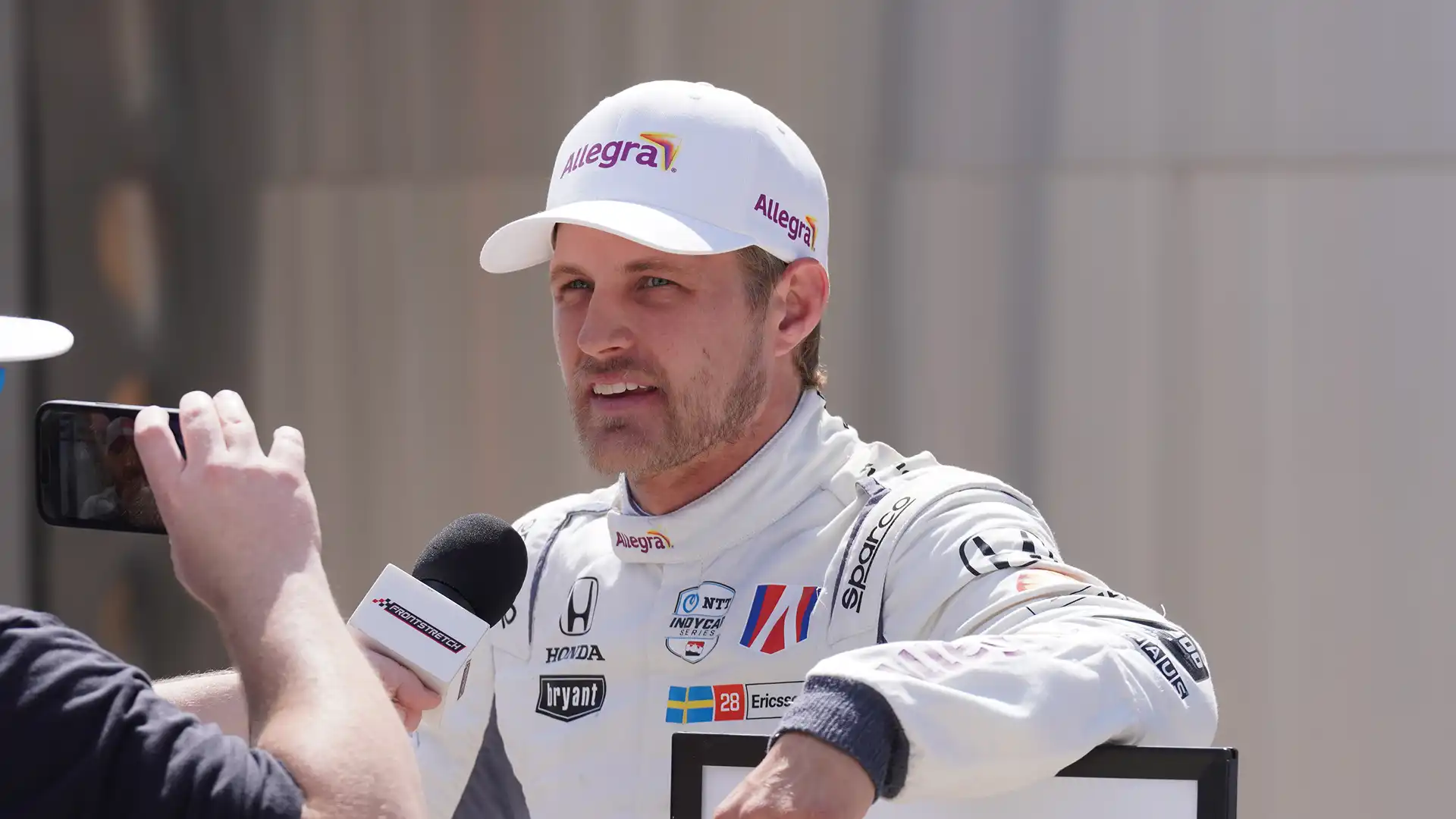


Marcus Ericsson left his Formula 1 dreams behind to try his hand at IndyCar. He then won the biggest race in the world.
Marcus won the Indianapolis 500 in 2022 after spending five years in Formula 1 fighting for P15 finishes. Making the move to IndyCar changed everything. After numerous wins and podium finishes, and securing his seat with the legendary Andretti IndyCar Team, Marcus has proven he belongs among IndyCar's elite.
Now it's all about finding consistency and earning more than just another Brickyard win.


A week-long Indy 500 celebration in Sweden [0:00]
Marcus: When I won, the King of Sweden reached out and congratulated me.
Greg: That's pretty sick.
Marcus: Yeah, that was pretty sick. We had a week of celebrations, I was on every TV show just celebrating, and we were bringing the Borg Warner Trophy everywhere. At end of that week of celebration, we had a big event in my hometown, a small little town in Sweden. And basically the whole city came out to celebrate. It was like 15,000 people on the streets just celebrating me and my win. It was definitely really cool because that's the thing, you know, being from Europe, being from Sweden, you race here in the US and I know how big it is here, the 500 and everything, but to see actually how much it meant for people in Sweden was really, really cool.
How winning the Indy 500 made all the sacrifices worth it [0:36]
Greg: So when you won the Indy 500, you said it was the greatest feeling there is. How does it change your life as a driver to win a race like that?
Marcus: For me, all my career, you obviously dedicate your life to racing. You live abroad and you don't see family and friends much at all because you're so dedicated to try and succeed in motorsports. Just to participate in the 500 was a dream come true since it's the biggest race in the world. So, that was a big achievement just to participate and then to eventually win the biggest race in the world, get your face on the Borg Warner Trophy and all that, it sort of makes all your sacrifices, all your time, everything you put into this, it makes it worth it a million times over. So for me, that was the biggest thing, sort of a relief and unreal feeling and all that work being put in meant something there.
Greg: Does it change how people interact with you? The next day, do you feel it? Are there different opportunities coming in that hadn't come before? Or is it back to the job, other than Detroit being right there?
Marcus: Yeah, I mean racing is a weird sport where you're never as good as your last race in a way, but the cool thing with the 500 is that you will forever be a 500 champion. So, in some sense, it changes the trajectory of your career because you will always have that 500 win. But also, you know, it puts a certain amount of expectation on you as well, that you are a 500 champion, you should deliver as a 500 champion, you should always be there in the mix. And I've been proud to do that, the years after my win, I finished second the year after, and almost won it back to back, and then second again this year. So I've shown that I'm strong around that place and strong when it matters the most.
Greg: Where did the Kumla dragon nickname come from?
Marcus: I don't know, I think it was some journalist that named it like a dragon, the way I was defending that win. Yeah, it was cool.
Greg: Have you stuck with it since?
Marcus: Not really, no. That was like the one and done move that I did that year, I think.
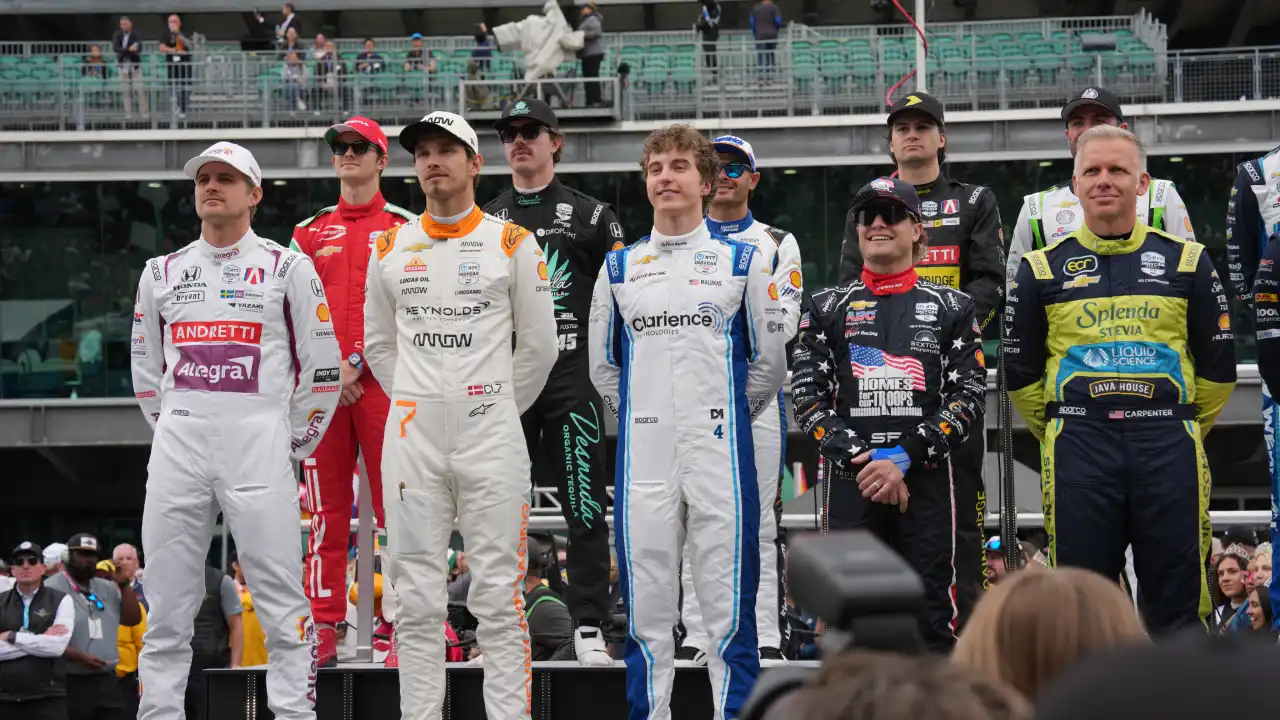
Kenny Bräck's support of Marcus's early career [2:32]
Greg: Before Marcus was Indy 500 champion, he spent five years in Formula One. It was a huge challenge, which he'll explain shortly, but to get there, he first needed the right people to back him.
When you were climbing the junior ladders, what was it like having a guy like Kenny Bräck, if I'm pronouncing it right? What was it like having a guy like him backing you early on in your career—someone you had watched on TV and now is supporting you?
Marcus: It meant a ton because I did go-karts and didn't really have a financial opportunity to continue my career. And then Kenny and his group of investors and people stepped in and sort of saw my talent and really helped give me the opportunity to be a racing driver. And also throughout the years we were working together, me and Kenny, worked extremely close together. He taught me a lot in my early years where you learn so much, so it really helped shape me and the way I am as a racing driver and I'm very, very thankful for that. Obviously, like I said, I was growing up watching Kenny. I watched him win on TV with my dad, you know, back when I was a kid. And to follow in his footsteps and be the second Swede to ever win the 500 was a really cool moment.
Greg: Yeah, it's pretty special.
Marcus: Yeah.
Marcus Ericsson's time in Formula One [3:39]
Greg: Before you came to IndyCar, you were in F1. What did that period teach you about yourself as a person, as a driver? What were the big things you took away from it?
Marcus: I think mentally, to be in F1 is really tough because, you know, F1 is so much about what team you're in, what car you're in. And I was there for five years, always running in smaller teams with less resources than the big teams. And mentally, it was tough to, you know—being used to fighting for wins every weekend. And suddenly you're in the back fighting for P15. And just that sort of change of focus was really tough mentally to get used to. And I never really got used to that. It was really draining to, you know, never feel like you succeeded even if you maximized your result and finished eighth or whatever. Still didn't get the same feeling as winning a race.
Greg: Yeah, it doesn't feel like the win.
Marcus: It was tough, but I'm still very happy I did it. It was an amazing experience and to be able to say I did five years of Formula 1 racing—97 Grands Prix—there's not many people who can say that. So I'm very proud of that. And I'm very lucky to have had the chance to do both Formula 1 and now IndyCar.
Greg: Well, I I think on that, right, there's a lot of drivers who have even come to IndyCar, who have maybe gone as close as F2 or reserve driver—to have many years and that is already a huge accomplishment. Is there any advice or maybe something you would say to people about coming here instead as a really good opportunity or a good pathway?
Marcus: Especially in Europe, a lot of people are so focused on Formula 1 because it's the ultimate goal and everyone wants to be a Formula 1 driver. But I think that's the thing. There are many other series that are also very fulfilling and very cool to drive. Obviously IndyCar, I love it. I think it's amazing. But even IMSA, WEC, all these series—there's a lot more to racing than just Formula 1. So I think that's the biggest thing. When I was in F1, I was so focused on that bubble of Formula 1 that you sometimes forget how many other cool things you can do in the motorsport world.
Greg: Speaking of doing cool things, now that you're here, how did that differ from that time in F1? You said, obviously, it was mentally difficult in the F1 seat when you weren't in as dominant of a car. When you come to IndyCar, what changes?
Marcus: I think one of the big things for me was just the opportunity, right? In IndyCar, everyone has the same cars to work with. So every weekend you have an opportunity to win. And just to have that mindset going into race weekends was big for me. It really gave me lot of energy to work even harder and prepare even more to be back in victory lane. So that was, I think, the biggest thing. And then just the American type of racing is a little bit more chill in a way. You know, it's still serious, but it's just like a bit more feel good versus F1, which is so like bloody serious in every moment. So, that's also been really cool.
Mentoring his younger brother, Hampus Ericsson[6:06]
Greg: Have you mentored any other younger drivers to come over?
Marcus: The biggest one is my youngest brother, Hampus. He's a racing driver. He's 12 years younger than me. So I've been coaching and mentoring and managing his career.
Greg: What's it like being an older brother, having had your career already so far and have all that experience and watching him following your footsteps?
Marcus: It's really cool, and obviously I try and teach him from the things I learned throughout my career because racing is a very special industry and there are so many hard decisions to make and you have to pick the right path to go down. It's been really fun to be part of that and try and help him succeed. This year he came over to the US for the first time racing here. He's racing in the Lamborghini Super Trofeo Championship here the US and they've won a few races and are fighting for the championship. He's been doing really well and we're trying to get him to IMSA eventually. A dream of mine is to do a Daytona 24 Hours together with him and share a car, so hopefully one day we'll do that.
Driving for Andretti IndyCar vs. his time at Chip Ganassi [7:05]
Greg: So now that you're in IndyCar, you're with Andretti. It's obviously a very special name to be wearing on your uniform. What does that feel like? How does that affect you as a driver in this mental game kind of thing?
Marcus: It was really cool just joining Andretti and joining that legendary name and getting to know Mario a bit, and Michael, and Marco, and the whole Andretti family. It's been really cool and just to represent them on the motorsport stage, I'm very thankful for that and proud of that. It's been really cool. I wish we had some better results together, but we still have time for that.
.webp)
Greg: Yeah. And then coming from Chip Ganassi to here, this, was there a difference between the two teams that you felt in terms of that legacy or anything else?
Marcus: Yeah, I mean, it's two of the best teams in the series and I think both do their things a little bit differently. So, two super teams, very good people, good teammates. In many ways, they remind me of each other as well.
Engines rev in the background.
Greg: We tried this one time where it was like seven [revs] back to back!
Loving Indianapolis and missing his home in Sweden [8:06]
Greg: So you grew up in Sweden, obviously. You raced in Europe and Asia. You then moved to the US. We've heard you loved Indianapolis and loved living there. What are some of the things about that that's special? What are some of the things about back home that you miss and wish you were seeing more of here?
Marcus: Yeah, the living here in the US, since I joined IndyCar, I straight away went to live here in Indianapolis. I haven't regretted that, I really love Indianapolis and it's become home for me and my wife.
Greg: Was there anything that like stood out to you immediately when you got here? Or thought like, this is really weird?
Marcus: I think the people in Indianapolis are super friendly. I think the fact that people drive everywhere is very different to Sweden. We walk a lot more than the American people in general. So that's just some different cultural things. But [Indianapolis] is a super easy place to live in. I really enjoy it. It's obviously the home of IndyCar so it makes a lot of sense being there. Yeah, of course, I miss family and friends from back home. Naturally, that's a big thing, but now since two years we have a big house in Indy, so I have family and friends come over and visit, so that's been really cool.
Greg: When you go back home, is there something that you're like grateful to finally have? Maybe it's walking everywhere, I don't know.
Marcus: Yeah, exactly. No, I mean, it's mainly the people that I miss. Sweden, it's beautiful in the summer, but we never really go there in the summer because that's when we race. When I go there, it's always the winter and that's the worst time to go to Sweden because it's super dark and cold and miserable. So it's mainly as I go there for people, you know, seeing family and friends that I don't get a chance to meet so much during the year. So I think that's the biggest thing that I miss living over here.
Greg: You never wanted to be a DJ with all the cold and snowy nights in Sweden?
Marcus: I mean, I don't really miss that. I prefer the weather here in Nashville where it's hot and sticky over the cold and snowy Sweden.
Driving around with Iris (Marcus's wife) [9:52]
Greg: A couple of years ago, you drove your wife, Iris, around in a pace car. She was screaming the whole time. Did she ever get revenge on you for that?
Marcus: No, not really. I mean, I usually drive when we're like road tripping or so, but she's a good driver actually. She just doesn't like to drive with me because I'm trying to 'help her' too much. It starts big arguments.
Greg: You're a backseat driver?
Marcus: Yeah 100%. So, usually I drive. It's good for the peace and quiet of the car ride.
Greg: Does she pick the music then?
Marcus: Yeah, but we have a good mix of that, you know, let's put it that way.
What 2nd at the 2025 Indy 500 meant and 2026 goals with Andretti [10:28]
Greg: Last question, looking back at this whole season, what's the highlight for you?
Marcus: Not many, unfortunately. It's been a tough year for us and for me in particular. It's been just one of those years where things just pile up going in their own direction. I still would pick the 500 finishing second there. Finishing second is the worst place, really, but it was a good effort from us, a good Month of May, and I'm proud of our performance there. And then whatever happened after happened, but I'm still proud of that performance that we brought on the biggest stage for the biggest race. So I still would pick that.
Greg: So then maybe looking at 2026, what do want that year to be?
Marcus: I need to find my consistency. I was proud of being a very consistent performer over many, many years in IndyCar, always finishing in the top 10 and being up front. We lost that this year, so we need to find back that consistency and winning races again. A lot of work is required this off-season to get back to that, but I'm ready to put the work in.
Want more exclusive Insiders?
Then you're in the right place! Head to our YouTube playlist for more, and be sure to subscribe to be the first to see new episodes. Or you can check out some of our recent episodes below:

.png)
.png)