

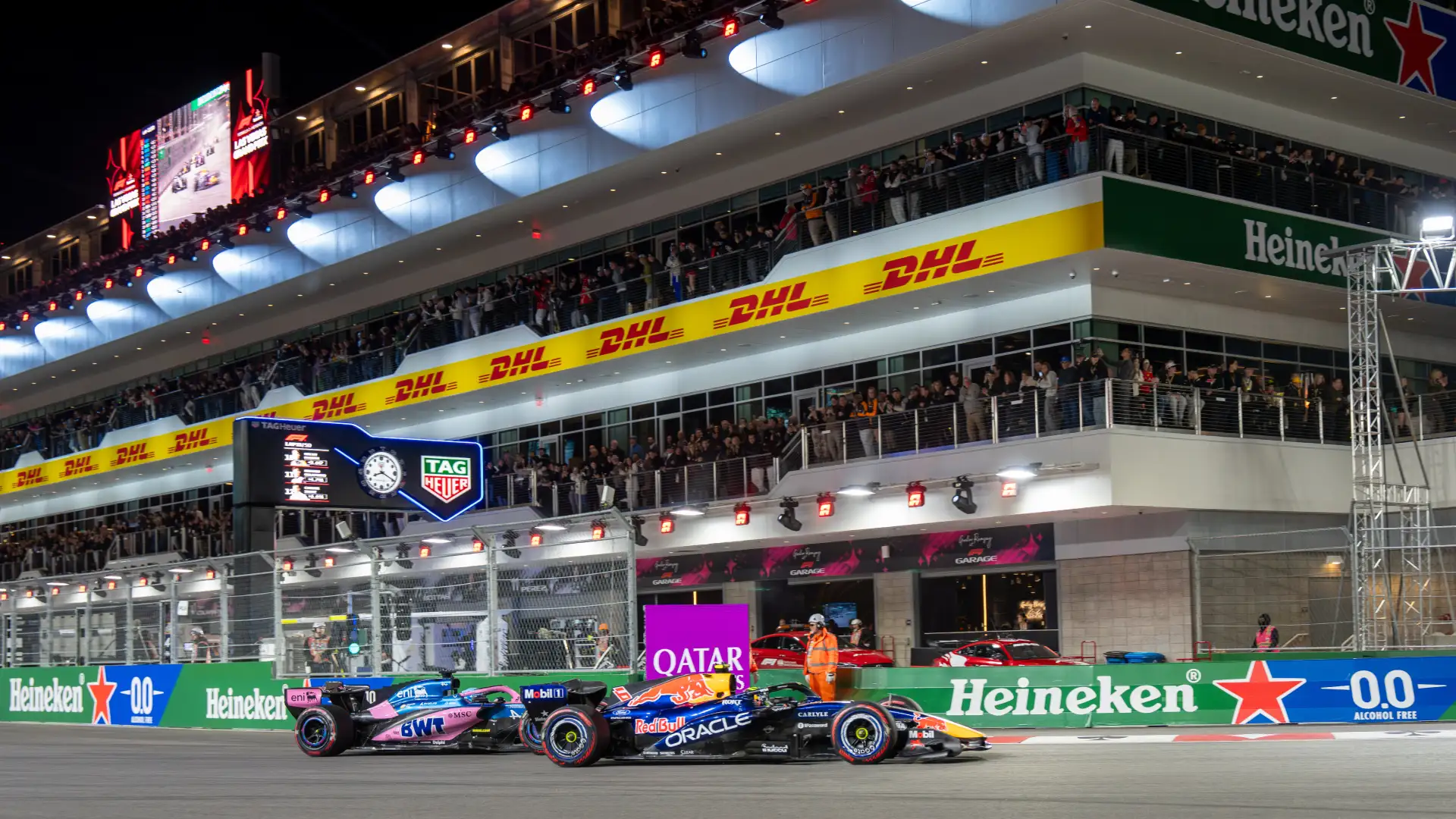


In 2020, the COVID-19 pandemic brought the world to a standstill. For a global sport like Formula 1, the impact was severe: 13 of its 22 planned Grands Prix were canceled. And although eight replacements were eventually added, the final season total sat at just 17.
Yet in the wake of that uncertainty, F1 went to work on what would become the Las Vegas Grand Prix (LVGP), its first and only owned and operated race. From the first in-person meeting with Las Vegas officials in September 2021 to the public announcement in March 2022 and lights out in November 2023, it took a little over two years for F1, the city, the resort and casino groups, and the local businesses to come together and deliver a race from scratch. The goal, as Emily Prazer, Chief Commercial Officer of Formula 1 and President and CEO of the LVGP and Grand Prix Plaza, envisions it: an annual Super Bowl for the city, staged during one of its slowest weekends of the year.
It also took money. F1 has invested more than an estimated $650 million to bring the race to life, and the Las Vegas Convention and Visitors Authority (LVCVA) just committed another $10 million per year for 10 years to support it.
But while the amount F1 bet on Las Vegas is staggering, the real questions are how this race comes together and what it means for the futures of Las Vegas and Formula 1.
I read, listened, and even traveled to Las Vegas to find out, looking at three layers behind the 22 cars on track: the permanent and temporary infrastructure that makes racing on the Strip possible, the people who make it run, and the programming that fills the weekend around it.
In this three-part series, I’ll take you through each layer one at a time, starting with the build. Here’s what I learned.


Infrastructure: The invisible back of house
How do you build an F1 circuit that runs on roads people depend on to get to work?
From the Super Bowl to EDC Las Vegas, the city is no stranger to hosting major events, but racing F1 cars through the heart of Sin City, in a race that drew 165,000 unique visitors last year, requires infrastructure few others can even match.
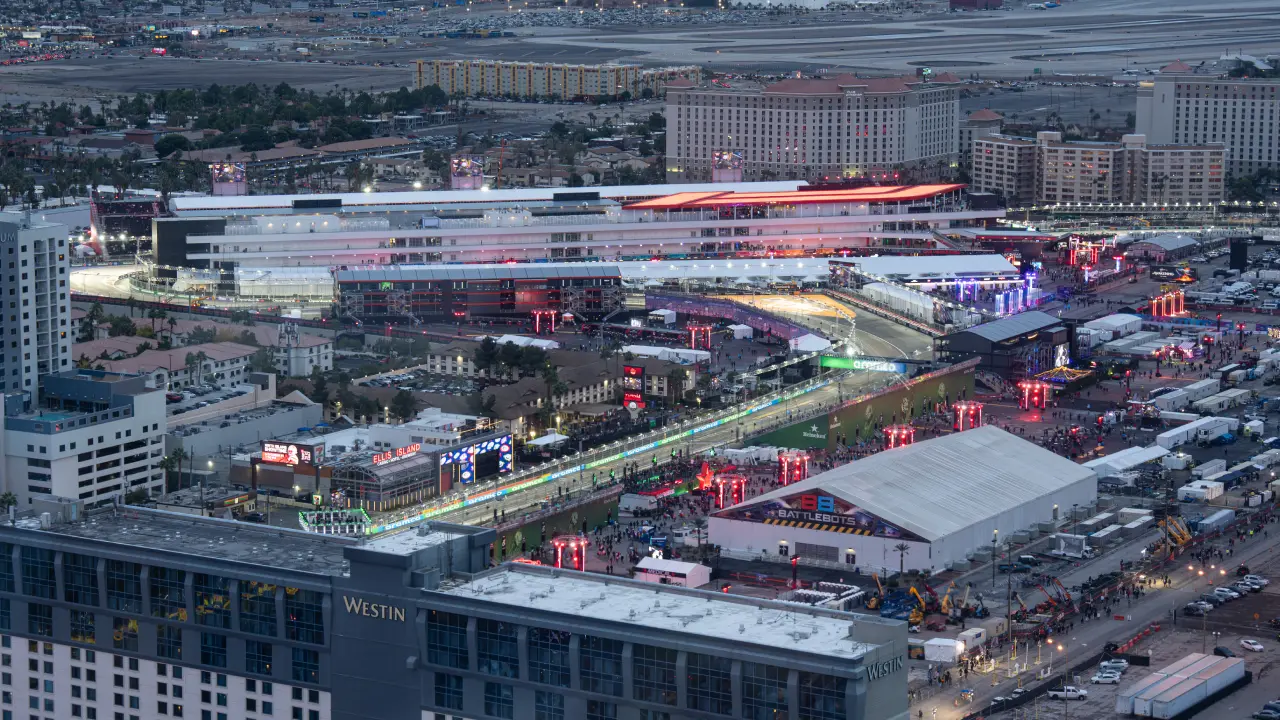
Before anything could move forward, F1 had to buy the ground. They paid $240 million in cash in 2022 for 39 acres, according to Racer. Then came the building: the Grand Prix Plaza, a permanent, 300,000 square foot (27,900 sq m) paddock building built to host the race and other year-round events.
Steve Hill, CEO of the LVCVA, the government entity responsible for promoting Las Vegas on the global stage, put a price on the whole thing in 2023, with what Forbes called “back-of-the-cocktail-napkin math.”
“They’re putting up a permanent 300,000-square-foot paddock building that is likely costing $1,000 per square foot,” he said to Forbes. “Then they’re going to be spending over $100 million on the circuit itself. So that’s $650 million before you think about all the people that they employ and all the other miscellaneous things they’re spending money on.”
Racing on public roads

It’s also more complicated than just filling potholes. You see, Formula 1 can’t just race anywhere with a paved road. Its tracks must hold a Fédération Internationale de l’Automobile (FIA) Grade 1 license, a bar only 40 circuits in the world currently clear. Las Vegas had to earn and maintain it without permanently closing roads: crews paved through rolling closures, and the roads must reopen to the public every night after the racing ends.
“Formula 1 is set apart because the entire event is also our entire commercial,” Steve told me in a quiet Las Vegas podcast studio decorated with a Las Vegas-themed racing helmet and shoes. “At Allegiant Stadium, you’ll see great spots between plays or between quarters or at halftime, but during the event itself it’s on the field, and rightly so. Formula 1, the entire event is also what we want to display.”
Achieving that visibility helps explain why the LVCVA was so committed to making this race work, and it’s also why the build couldn’t hide inside a stadium. It had to run through city streets, in a city that quite literally doesn’t sleep.
Why the price tag was so high
For scale, Qatar’s Lusail International Circuit was built from scratch in the desert in little over a year for $58 million in 2004. Spain’s new Madring Circuit, which runs mostly through a private exhibition center, carried an €83.2 million (about $95 million) construction contract that included temporary structures and road restoration. Las Vegas built its track almost entirely on city streets, in the middle of its busiest corridor, so it’s easy to see where that $100 million went.
And separate from what Formula 1 spent, it’s Steve’s organization that just committed $100 million through 2037 to sponsor the race through ticket purchases and covering race support costs like paying for police and firefighters (more on that in part 2). “A part of our sponsorship goes to that,” he said.
The LVCVA’s commitment also came with the expectation that setup time would accelerate, and that the impact on the public during that period would become less severe.
Cutting the setup from nine months to 11 weeks
The setup was nine months in year one “because we had to actually pave the circuit itself. So that was five months of the nine,” Steve said. For 2026, that number was down to around 11 weeks, something various shuttle and Uber drivers I spoke with felt much better about.
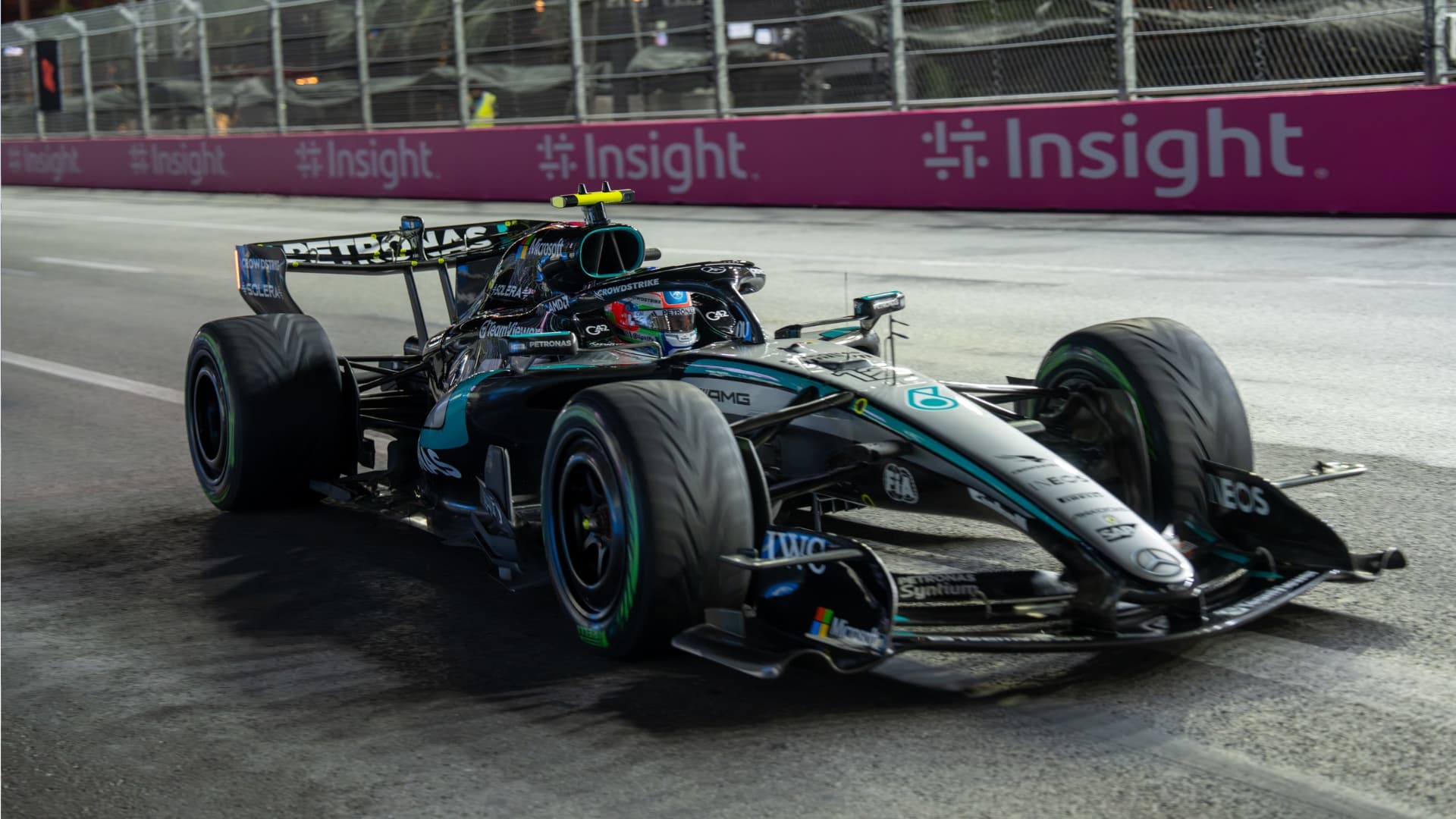
In that timeframe, teams are responsible for installing 1,750 temporary lights and 7.6 miles (12.2 km) of track barriers along the 3.8-mile (6.2 km) track. Six temporary bridges—three for cars and three for pedestrians—are installed to keep intersections open even when the track is hot.
But there is more work to streamline this process, and the lights are next. Today they go up on temporary stanchions held upright by concrete blocks. Steve says that’s about to change. “What we will do in the future, and Formula 1 will do, partly with our contribution and partly theirs and others, is install light bases so that you can come plug the light in. It looks like a permanent fixture, very easy to install and remove, and cuts down on time.” Those investments hinge on certainty: with the race locked in through 2037, F1 has a reason to build things that stay.
The long list of temporary infrastructure
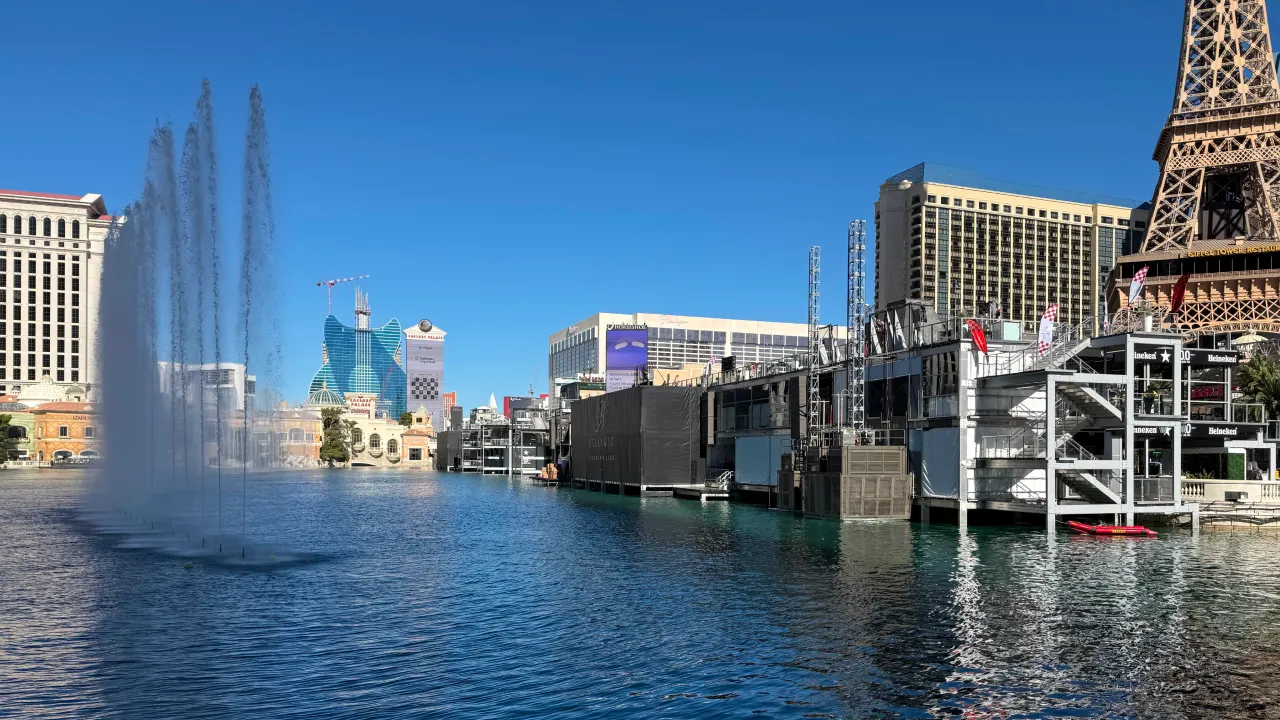
Around the circuit, crews build 11 grandstands, 10 General Admission viewing decks, two concert stages, and hospitality structures like the Bellagio Fountain Club, where kitchens turn out menus from Michelin-starred chefs like Morimoto for guests who never leave their trackside seats. T-Mobile layers on 20 5G-connected cameras to aid the broadcast, while Community Ambulance leverages FirstNet GPS tracking to monitor the movement of medical teams, something they had to fix after a different system struggled under the heavy network crowding during the inaugural Las Vegas GP in 2023.
“We’re able to see exactly where our foot teams are at all times, where our cart teams are at,” Glen Simpson, Vice President of Community Ambulance, told me from his home office ahead of race day. So that “if something does go sideways, because that’s the world we live in, if there’s an incident within the incident, that we’re even more prepared, and better prepared, for when that may happen.”
“A lot of times when we think about the fan experience, we don’t always think about the back of house or the operational experience and how much goes into it,” said Amy Azzi, Vice President of Sponsorships and Events at T-Mobile, at the F1 Business Summit. “But that operational experience has to have so much infrastructure, so much connectivity, to be able to produce a seamless premium experience.”
The scale of it all

When all is said and done, the circuit encloses an estimated 30,000 to 35,000 hotel rooms and covers roughly 10 times the land of a typical stadium event. “If you think about an NFL stadium, Major League Baseball stadium, NBA arena, you think about the Super Bowl, those typically have maybe a 20-to-45-acre footprint. We have a 450-acre footprint,” Terry Miller, General Manager of the LVGP, said in a 2025 Track Limits interview. “It’s on the level of an Olympic event.”
All of this is invisible when it works so well that fans can simply enjoy the race. Making it work, though, takes something no contractor can install.
What else does it take to run the Las Vegas Grand Prix?
That’s it for Part 1 of this deep dive into Formula 1’s estimated $650 million bet on the Las Vegas Grand Prix. Check back Friday for the people who make it run (Part 2), then on Monday for the programming and what it all means for Las Vegas and F1 (Part 3).