


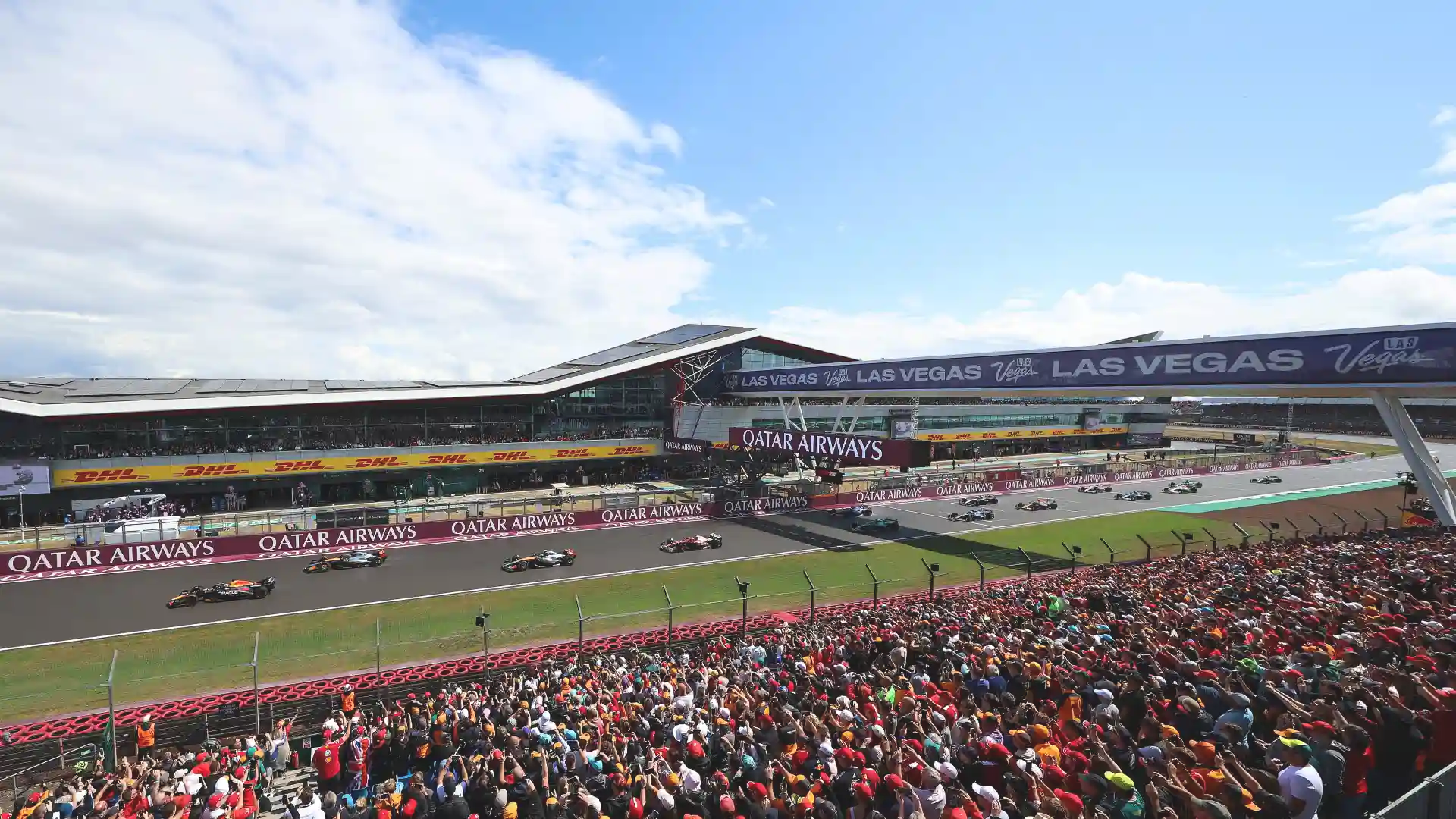


If there is one race that Formula 1 as a whole can call home, it is the British Grand Prix. This race traces its roots to the earliest days of F1, including spectacular moments from before the sport even existed. So today we’re digging into the vast history of racing’s heart in the UK. From the wartime origins of the Silverstone Circuit to a lap one crash that changed F1’s safety standards forever, here are three things about the British Grand Prix that you probably didn’t know!


From bomber base to Grand Prix circuit
The site that Silverstone Circuit is located on was not always a race track. In fact, the grounds were originally known as the Silverstone Royal Air Force (RAF) station, used by the RAF as a training base for Britain’s Vickers Wellington bomber planes. The station was shut down in 1946, shortly after the end of the war, leaving behind a wide open space with long runways that stretched out for up to a mile in length. In other words, it became the perfect location for local speedsters to gather and hold informal races, also known as thrash races.
And indeed, the venue was so popular among racing fans that it didn’t take long for the area to be turned into a proper racing circuit. The first official British Grand Prix was held in 1948, two years before F1 was established as a racing series, and made use of several of the airfield runways for its track. The Silverstone Circuit has since gone through several iterations, but to this day parts of the airfield are still used throughout the circuit grounds. This includes the main Wellington Straight, running between turns 5 and 6, which was formed from one of the old runways of the RAF station and is named after the bombers that trained on these grounds.
The circuit that breaks the home race curse
From Monaco constantly torturing Charles Leclerc to the Australian Grand Prix rarely seeing a local end up on the podium, let alone finish, it certainly feels like home races in F1 come with a bit of a curse to them. In more than 1,100 F1 races that have been held since 1950, only 83 times has a driver won their home race. What’s more, only 38 drivers across 14 different countries have managed to achieve this. And of those 14 countries, one stands out as the most successful: Great Britain.
To date, the British Grand Prix has been won by 13 different British drivers a total of 29 times. In comparison, the next most successful country is Germany, which has seen a local driver take home a race win just 12 times. Of course, the disproportionate number of British winners can be partially attributed to the fact that the UK has produced a massive number of F1 drivers.

Regardless, of those 29 British wins, 18 were achieved by just three drivers: Jim Clark (five wins: 1962, 1963, 1964, 1965, and 1967), Nigel Mansell (four wins: 1986, 1987, 1991, and 1992), and Lewis Hamilton (a staggering nine wins: 2008, 2014–2017, 2019–2021, and 2024).
Of note, Hamilton is currently tied with legend Michael Schumacher for most home wins, with nine (Schumacher won the German Grand Prix a total of four times, and the European Grand Prix hosted at the Nürburgring five times), making him one of the most successful drivers both at home and at Silverstone specifically. His most recent win was an emotional one in 2024, during his final year with Mercedes before moving on to Ferrari.
A lap one collision led to stricter safety standards
The F1 we know and love today is far safer than it ever was, with great care being taken to protect drivers, mechanics, marshals and the audience during race weekends. But every now and then, an incident occurs on-track that forces the sport to pause and reassess its safety standards.
Such was the case at the 2022 British Grand Prix. The opening lap of this race saw a multi-car collision triggered by a touch between the Mercedes of George Russell and the Alpha Tauri of Pierre Gasly. The touch caused Russell to collide with Guanyu Zhou, whose Alfa Romeo was swiftly flipped upside down, skidded at high speeds along the track into the run-off area, and eventually lodged into the catchfencing around the track. It was a horrific sight to see, and while the halo played a part in saving Zhou’s life, examination of his car after the collision revealed something even more chilling.
In the crash, the roll hoop of Zhou’s car had broken off and was missing from the recovered chassis. The roll hoop is the component directly behind and above the driver’s head, intended to protect them from head injuries should the car flip over, like it had during this incident. The discovery that it had so easily been torn off of Zhou’s car that day at Silverstone in 2022 eventually led to stricter safety measures around the construction and testing of this part. From 2023, higher load tests and improved roll hoop attachment requirements were introduced in an effort to keep F1 as safe as possible.
Want more surprising facts about this year’s F1 drivers and race tracks? Sign up for our newsletter for a bonus fact about Barcelona, and be sure to check out our other Speed Reads:
- 3 Things You Didn’t Know About the Austrian Grand Prix
- 3 Things You Didn’t Know About George Russell
Images via Red Bull Content Pool


.webp)



.png)
.png)