


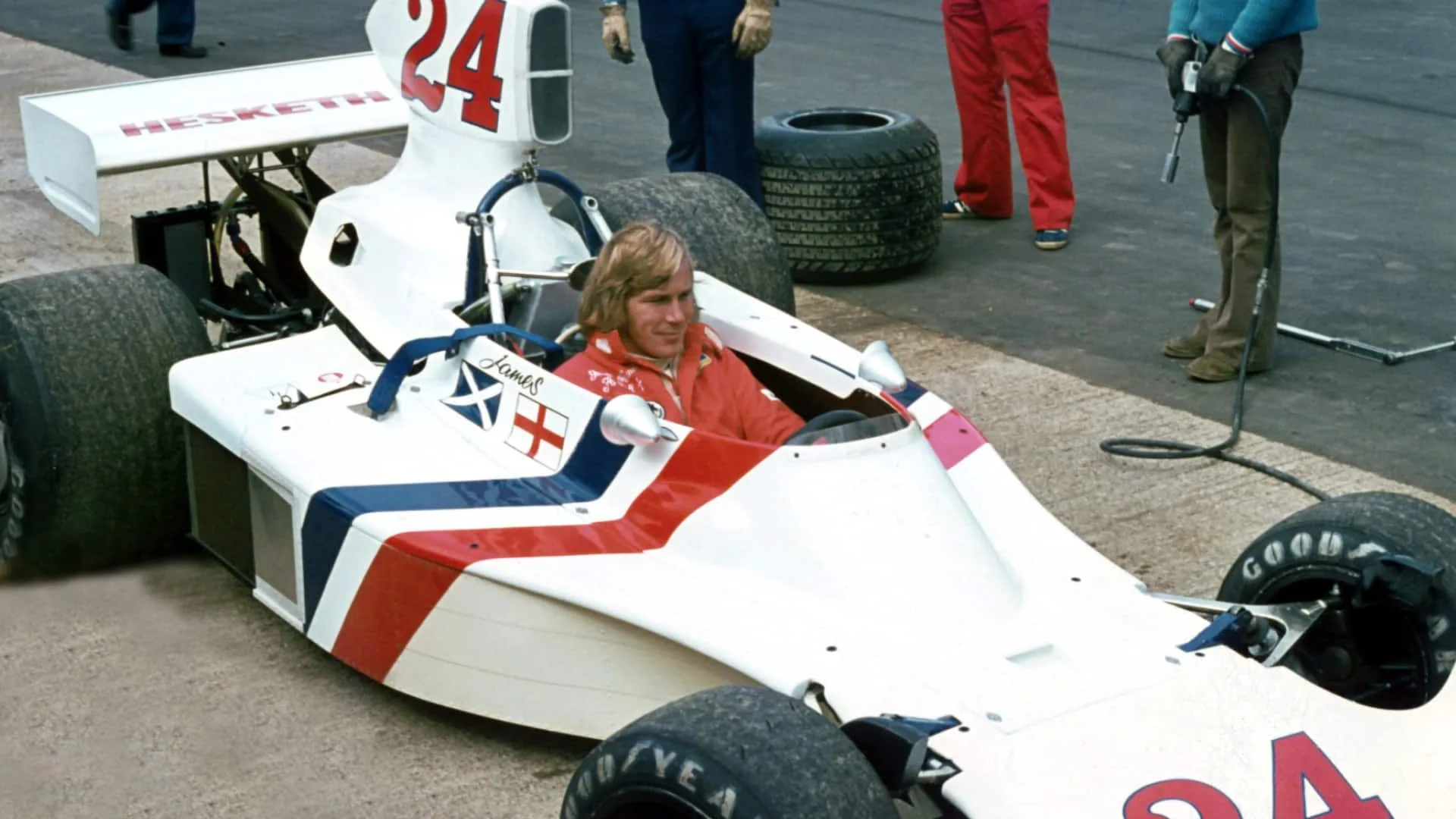


The Formula 1 2026 summer break is finally over, and we are headed back to racing at none other than Max Verstappen’s very own home race, the Dutch Grand Prix. But Max Verstappen isn’t the only driver who has left a mark on this historic circuit. From James Hunt’s first career win and the time that Gilles Villeneuve drove on just two wheels, to the drivers refusing to race on a track that had gained a deadly reputation, here are three things you probably didn’t know about the Dutch Grand Prix.


James Hunt’s wild first—and Hesketh’s only—win
We all have to start somewhere, and the same is true for motorsports legend James Hunt whose risky race strategy paid off in spades.
Hunt joined Hesketh in 1973, making his F1 debut that same year at the Monaco Grand Prix. Yet despite some decent performances (including his maiden podium with a third-place finish at the 1973 Dutch Grand Prix), the first few years of his F1 career were full of growing pains, and it wasn’t until the 1975 race at Zandvoort that the Brit claimed the top spot of the podium.
Despite a dry and sunny Qualifying, race day Sunday began with a downpour that prompted most teams to switch over to a wet setup for their cars. Seeing a tiny break in the clouds far off in the distance, however, the Hesketh crew decided to stick with their dry Qualifying setup and by the time the cars had lined up on the grid, the rain had halted to a near stop.
“We came in lap six seven or something,” recalled team owner, Lord Alexander Hesketh, to Jenson Button in a 2022 interview with Sky Sports, “and [Hunt] went out on dry tires, and there was a dry line. After a couple of slips, he didn't come off, and the tracks started to dry.”
The call was an excellent strategic move that gave Hunt and Hesketh a major advantage over the rest of the field, and ultimately brought Hunt sailing across the finish line ahead of everyone else. It marked not only his first victory, but the first and only victory for Hesketh Racing as a team.
Villeneuve gets his Ferrari home safe with just one hand and two wheels
F1 drivers can certainly pull off some crazy miracles with their cars, but few are as iconic as when Canadian legend Gilles Villeneuve drove around the entirety of the track on just three wheels. It was the 51st lap of the 1979 Dutch Grand Prix when Villeneuve found himself fully in the dirt at Tarzan with a punctured rear left tire.
Villeneuve was in no mindset to just give up, so he quickly started his car back up, hit reverse and pulled himself back out onto the track. By that point, the punctured tire was completely shredded and useless, but that did not stop him either. He drove out on three wheels, slowly winding his way down the track towards the pit lane with one arm raised out of the car to indicate to the competitors zipping by him that something was wrong.
But trouble did not end there for Villeneuve. Halfway around his lap, it became evident that the front right wheel of his car had lifted off the ground, effectively leaving him hanging on by just two wheels. He eventually got the car to the pitlane, to the raucous applause of his team, and while he ultimately retired from the race because of the damage done to his car, his arrival to the pit was treated almost like a victory itself.
A track so deadly that drivers refused to race on it
The Dutch Grand Prix may have had some epic and spectacular moments in its history, but it is also a race steeped in heartbreak and tragedy. This includes 1971, and the passing of Piers Courage, a British driver for Williams who lost control of his car after hitting a bump and went off at Tunnel Oost, a portion of the track that no longer exists. Courage was fatally injured in the crash, becoming the sixth driver to lose his life at the Circuit Zandvoort since 1952.
As a result of these incidents, in 1972 F1 drivers refused to race on the track out of protest for its lack of proper safety measures. After assessing the situation, the Commission Sportive Internationale (CSI), an early iteration of the FIA, ultimately decided that the circuit was not safe enough to race, and the 1972 Dutch Grand Prix was canceled.
The following year, major changes were made to the track. Major changes included broadening the width of the track, resurfacing it and installing steel guard rails in place of catch-nets around several of the corners. Certain sections were also completely redesigned, including a new corner that would help slow down entry into the Tunnel Oost.
.webp)
Nonetheless, 1973 became the year with one of the biggest tragedies in F1 when Roger Williamson lost control of his car, spun and hit the barriers, bursting into flames. Fellow driver, David Purley stopped his own car and attempted to rescue Williamson from the wreckage, however neither he nor the safety marshals were able to do anything.
That tragedy ultimately led to improved fire safety standards across F1, including the introduction of fire-resistant overalls for marshals to better respond to rescues involving fires, as well as an increase in the number of fire extinguishers available throughout tracks.
Want more surprising facts about this year’s F1 drivers and race tracks? Sign up for our newsletter for a bonus fact about the Hungarian Grand Prix, and be sure to check out our other Speed Reads:
%20(1).jpg)

.webp)

.png)
.png)
