


.jpg)


On June 19, 2005, exactly six Formula 1 cars took the green flag at the United States Grand Prix at the Indianapolis Motor Speedway. The remaining 14 cars on the grid, all donning Michelin tires, had pulled into the pits before the race began, leaving a crowd of bewildered and furious spectators watching a Grand Prix that had been reduced to a ‘contest’ between just six cars across three teams.
It was one of the most embarrassing afternoons in Formula 1 history. The immediate cause was a technical failure: Michelin brought tires that could not withstand the demands of the Indianapolis Motor Speedway circuit—specifically, the final turn, which was banked. The three teams that did compete all used Bridgestone tires; Bridgestone, parent company of longtime Indy tire supplier Firestone, knew how to build rubber that could last under these uniquely American conditions.
But how, exactly, did a Formula 1 race at one of America's greatest racing venues—a race that Michelin had produced tires for four times prior—fall apart so catastrophically? And why didn’t teams just switch tires when the issue arose? That's exactly what we're going to find out.


Indianapolis: The (almost) perfect American home for Formula 1
.jpg)
Formula 1 has had a long and complex relationship with the United States. In order to call itself a ‘World’ Championship when it debuted in 1950, F1 added the Indianapolis 500 to its calendar—even though only two F1-specific drivers ever tried their hand at an oval race during that period.
After two years of trying and failing to draw an audience to a proper United States Grand Prix, first at Sebring in Florida and then at Riverside in California, F1 found a regular home at Watkins Glen in 1961. Unfortunately, as F1 became ever more popular, it outgrew the rural confines of upstate New York, and both F1 personnel and local race organizers staged a series of disastrous street races across the US. After two decades of failure, it was time to try something new.
Enter: Indianapolis.
The Indianapolis Motor Speedway, first opened in 1909, had long since become an American institution by the time track owner Tony George sat down with F1 supremo Bernie Ecclestone in the late 1990s to organize a Grand Prix. To do so, IMS built a road course inside the 2.5-mile oval circuit, then scheduled its first event for 2000—nine years after the last United States Grand Prix in Phoenix, Arizona.
IMS came with several critical features that had been lacking at every other American F1 track. It was a permanent, world-class racing facility that understood how to host a major event. It also had a racing pedigree that the streets of Dallas or Phoenix did not. Taken together, an F1 race at Indianapolis would benefit both the track and Formula 1.
But perhaps most important was the fact that IMS came with its own dedicated audience of diehard race fans. The Indy 500 had long been an integral part of Indianapolis culture, building decades of tradition that Formula 1 could capitalize on. Gone were the worries that they'd organize a race only to have no one turn up. Indianapolis guaranteed an audience.
Unfortunately, the Indianapolis Motor Speedway also came with one corner unlike any other on the Formula 1 calendar: a high-speed banked turn that, in 2005, would expose just how many teams had bet on the same tire supplier.
How a grid built on Michelin rubber became a powder keg
.jpg)
Modern Formula 1 fans know that Pirelli is the sport's sole tire provider for all 11 teams, but for most of F1 history, that wasn't the case. In fact, it's been more common for two or more companies to supply tires to the grid than it has been for just one manufacturer to do so. (In 1954, for example, there were a whopping six different tire suppliers: Pirelli, Continental, Firestone, Englebert, Dunlop, and Avon!)
The existence of multiple tire manufacturers led to massive developmental battles known as “tire wars,” where each supplier would try to create a more durable, faster compound—and as every race fan knows, developmental battles are hugely expensive.
The battle between Bridgestone and Michelin is one of the most notable in Formula 1 history, even if it was brief. Bridgestone had joined F1 in 1997, with Michelin following in 2001. Both tire makers were known for pushing technological boundaries, but as the 2000s proceeded, Michelin began to take over more of the grid. By 2005, Bridgestone was only supplying three teams: Ferrari, Jordan, and Minardi.
Why? Part of it had to do with performance; Michelin had a tendency to perform better in hot conditions compared to Bridgestone, which was important for all of F1's summertime races. Michelin tires performed better in Qualifying as well as in extremely wet conditions—but Bridgestone tires were less likely to grain during a race and were preferable in damp but not ultra-wet conditions.
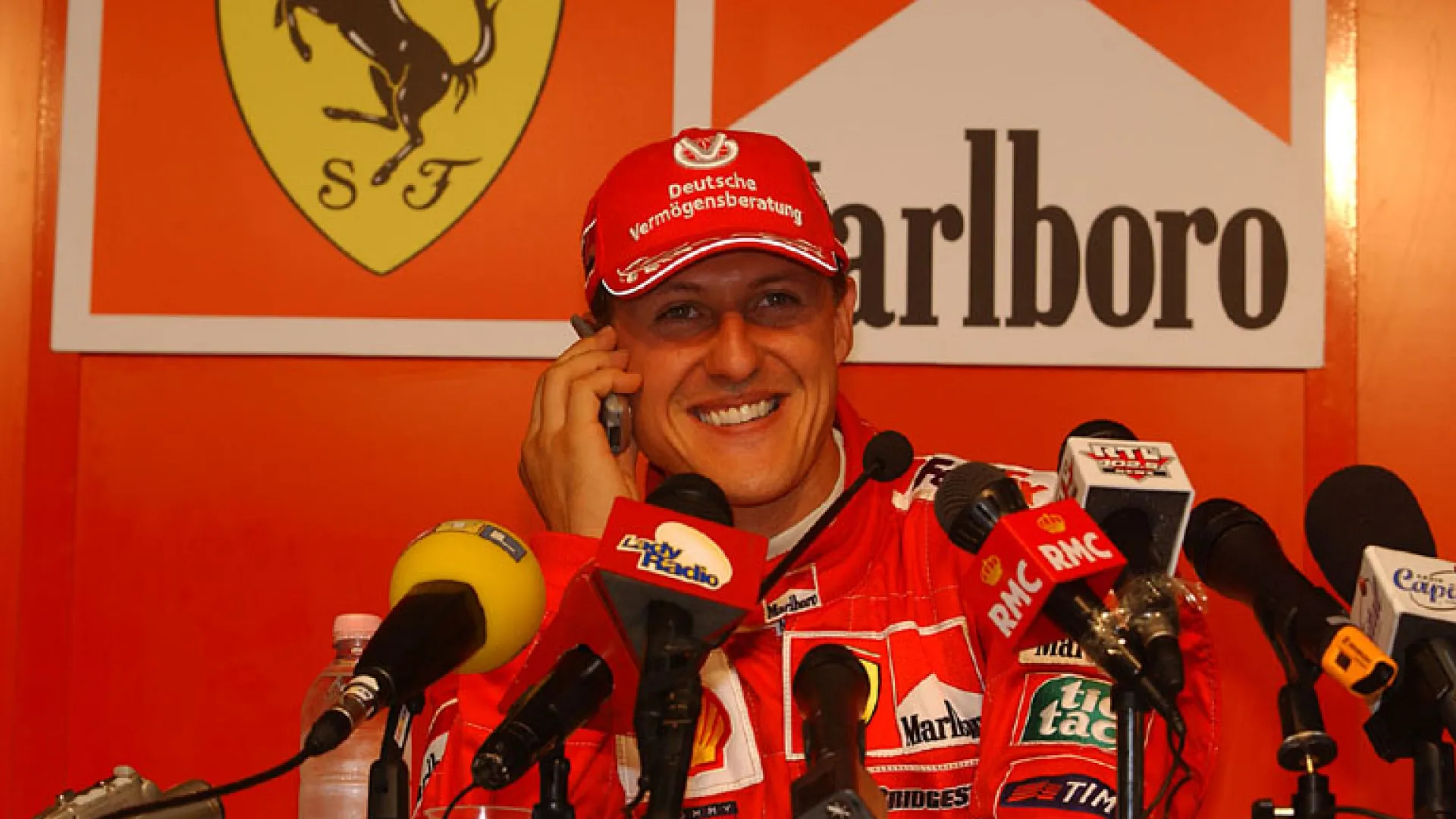
The big part, though, came down to the fact that Bridgestone prioritized its relationship with Ferrari over its relationship with all other teams. Ferrari was dominant, and by developing tires directly with Ferrari, Bridgestone could lower its costs while maximizing its chances of victory. The fact that Michael Schumacher scored five consecutive World Driver Championships between 2000 and 2004 while driving Bridgestone tires is proof of the success.
Obviously, that didn't sit well with other teams, who wanted their tire supplier to take into consideration the specific needs of their specific cars. Where Bridgestone mostly worked with Ferrari in terms of development, Michelin was willing to work with all of its customer teams. Naturally, many of those teams made the move to Michelin when it was clear Ferrari would dominate.
As Bridgestone and Michelin developed ever faster tires, Formula 1 and the FIA sought to rein in speeds in order to better guarantee safety; as a result, the FIA introduced a new rule for the 2005 season that banned mid-race tire stops and mandated the use of one set of tires for both Qualifying and the Grand Prix. The move would force both tire suppliers to manufacture harder compounds; those compounds would provide less grip and reduce cornering speeds, forcing drivers to go slower around the track.
The one-set rule, combined with Michelin’s reach across the grid, left no room for error. Any problem with its tires would affect 14 of the 20 cars, and with routine tire changes banned, there would be no easy way to fix it.
A banked corner and faulty tires lit the fuse
.jpg)
The 2005 United States Grand Prix was the sixth running of the race at the Indianapolis Motor Speedway, and the trouble started in Friday practice. Ralf Schumacher lost control of his Toyota in Turn 13 due to a left-rear tire failure. Schumacher had to withdraw from the weekend and was replaced by the team's test driver, Ricardo Zonta. Later that day, Zonta suffered a crash as a result of tire failure in that exact same corner.
The IMS road course's Turn 13 doubled as Turn 1 in the oval configuration, meaning it was a high-speed banked corner. Those kinds of high-speed banked corners were rare in Formula 1 at the time, and while a tire failure at Turn 13 a year prior had caused another crash for Schumacher, that corner wouldn't become a major problem until 2005.
Why? Well, there are multiple potential reasons. IMS had been repaved between the 2004 and 2005 runnings of the USGP, and the new surface was more abrasive. But Michelin was the only tire supplier having problems; its new tire was unable to cope with the high loads in the banked corner. Bridgestone, which had merged with longtime Indy 500 tire supplier Firestone in 1988, had tires capable of handling those high loads.
Michelin flew in a different tire compound for Saturday but discovered that compound was also prone to failure. It was time to change tactics.
Two Michelin representatives penned a letter to then-FIA race director Charlie Whiting in which they admitted they were unsure why their tires were failing in Turn 13, but that without any changes to reduce speeds in the corner, they could only guarantee their tires would last for 10 laps. That would be a problem for a 73-lap race.
Whiting replied via letter instructing Michelin to inform its drivers to slow down in Turn 13 in order to avoid any further blow-outs. He also struck down a few ideas that the teams had brainstormed overnight, which included Michelin using a different compound for the race, Michelin being allowed to change tires as needed, or the FIA adding a chicane ahead of Turn 13 to reduce speeds.
Michelin wrote back to Whiting, letting him know they would not allow their teams to race without some sort of modification. Whiting declined to change the track layout. However, he stated that he'd allow Michelin teams to use a different tire compound between qualifying and the race, albeit with a penalty. He would also allow Michelin to make as many pit stops as needed because those stops would be for driver safety.
On Sunday morning, a Michelin representative, Bernie Ecclestone, Tony George, and team principals for all teams except Ferrari attended a meeting to hash out a plan of their own. They agreed that limiting speeds in the corner would not work. They also agreed that pitting for new tires every 10 laps was impossible, given how many tires it would require. They determined that the only reasonable solution was to add a chicane.
Ecclestone proposed the chicane to the only two men who were not present at the meeting: Ferrari team principal Jean Todt and then-FIA president Max Mosley. Both rejected the idea of the chicane. The existing track layout had received FIA approval; the addition of the chicane would have meant the track no longer conformed to FIA standards.
The teams reconvened, where they instead proposed running the US Grand Prix as a non-championship race. That would mean that all FIA staff would leave, so there would be no one there to moderate safety or conduct, but it would mean that a chicane could be added. But that ultimately didn't happen, in part because the US Grand Prix organizers were worried about possible repercussions for other FIA-sanctioned events in America.
Finally, the Michelin-shod teams came to a conclusion: They would line up on the starting grid, but they would all return to the pits after the formation lap. The three Bridgestone teams all opted to race, worried about repercussions from the FIA if they didn't.
The result? Twenty cars started on track, but just six cars took the green flag for the 2005 United States Grand Prix.
The 2005 US Grand Prix became a sporting catastrophe
.jpg)
While fans were aware of the tire disputes, they had no idea that the Michelin teams had agreed to pull into the pits after the formation lap, so the six-car start came as a complete shock.
Thousands of the estimated 100,000 to 130,000 spectators in attendance had vacated the stands by Lap 10. Some went directly to the ticket office to demand refunds while others went straight home. Many of the fans that remained chucked trash onto the track surface, booed the six cars that competed, and made signs and posters expressing their frustration.
On June 28, nine days after the disastrous race, Michelin offered refunds to every fan who purchased tickets for the 2005 United States Grand Prix. Refund checks were mailed out in September. The following year, Michelin also distributed 20,000 free tickets to fans impacted by the 2005 fiasco.
But refunds and free tickets couldn’t undo the frustration of fans around the world who had witnessed the event. The failure of the 2005 US Grand Prix was obvious: Michelin built a tire that could not cope with the demands of Turn 13 at the Indianapolis Motor Speedway, the complexities of F1’s regulations made that mistake difficult to rectify, and the dispute that followed left the championship with no credible solution before the green flag. The result? A fiasco that rolled into the history books as one of motorsport’s greatest catastrophes.
Photos (tire carts, Mosley sign) sourced from Rdsmith4 via Wikimedia Commons under the Creative Commons Attribution-Share Alike 2.5 Generic license.



%20(1).jpg)




.png)
.png)

