

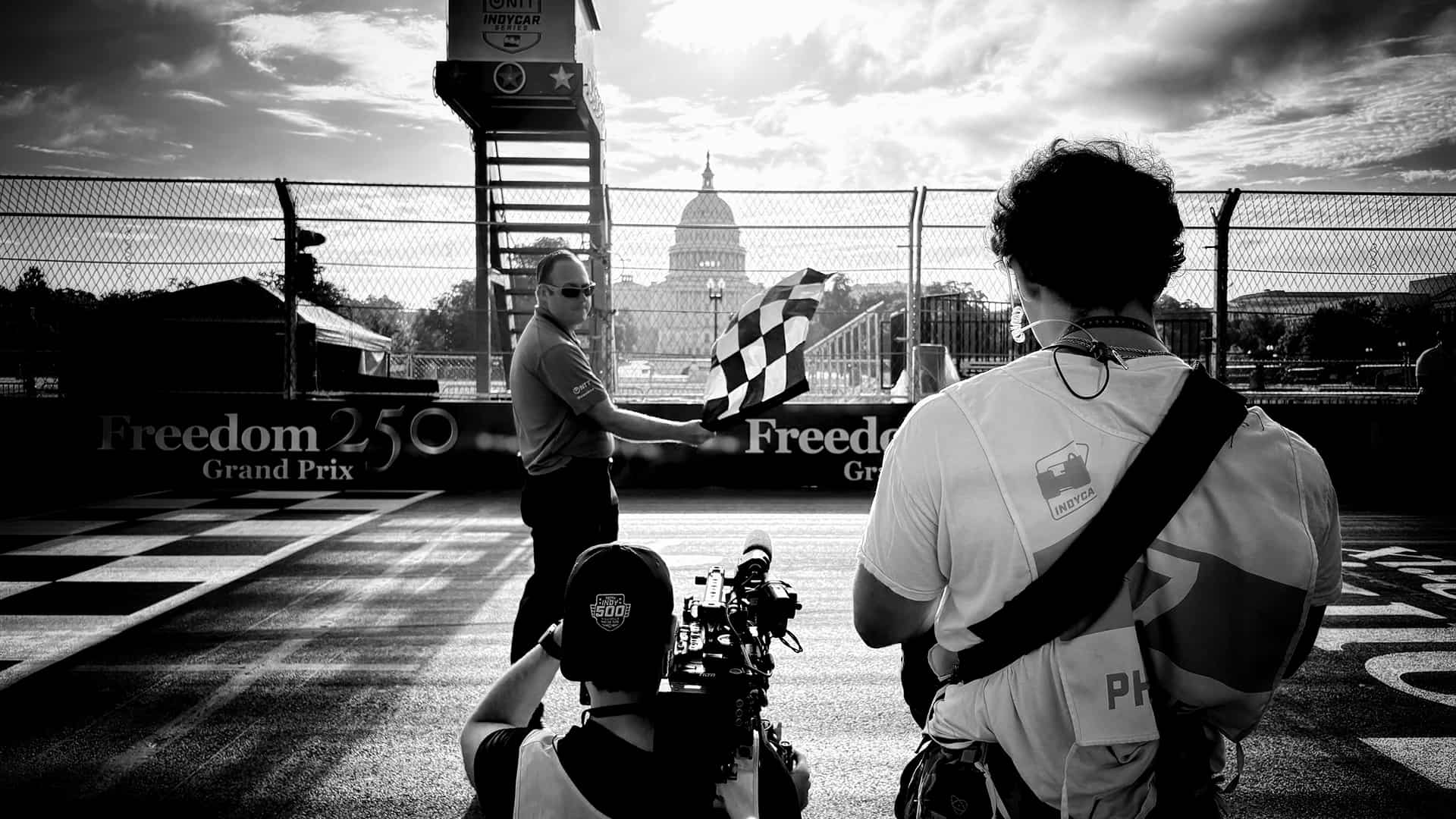


Derek Mindler may have prepared for the IndyCar season opener by driving the track on his sim rig, but not even that was enough to ready him for the mob of people he’d fight through to capture Alex Palou’s win.
Having never shot motorsports before he took on the director of photography role for the All In: IndyCar docuseries, Derek’s work in the paddock has been a trial by fire since that first race weekend. He needs to remain nimble and observant to capture fleeting on-track moments, while still operating in a more traditional environment for the planned interviews. It’s a balancing act that Derek, and his team, have been able to walk all season, banking incredible moments with drivers like Will Power, Scott McLaughlin, and David Malukas.
So, how does someone who had cinema skills and zero motorsports experience end up bringing IndyCar’s marquee docuseries to life? Keep reading to find out!
Position: Freelance Cinematographer and Director of Photography for All In: IndyCar.
Day to Day: I oversee the visuals of the All In: IndyCar show and make sure that we are capturing it with the style that we set out from the beginning.


How Derek Discovered Racing and Started His Career
What was the first moment you discovered racing?
My 18th birthday present was a NASCAR driving experience. I'd never really watched NASCAR or been into NASCAR before that.
But my mom for whatever reason got me this NASCAR driving experience for my 18th birthday. And so we went down to the Charlotte Motor Speedway and I got to drive Dale Earnhardt Jr.'s old NASCAR. And I think I hit 155 [mph] going around the oval.
Flash forward a bunch of years, and one of my closest friends, a director named Adam Engel—he's an avid, avid Formula 1 fan. And he had been trying to kind of get me into F1 for a while, and I ended up shooting some press content for the F1 movie.
And so me and a few friends including him all went to see the movie, and then after that we just started talking about F1 and racing more. Then Adam got me into sim racing a little bit. I guess you could say that’s how I got initiated.
How did the All In: IndyCar role come about?
I had shot several documentaries with the showrunner, Ryan Lohuis. We worked on a few History Channel documentaries together, as well as an ESPN documentary. And simultaneously I had been just starting to get into sim racing and F1.
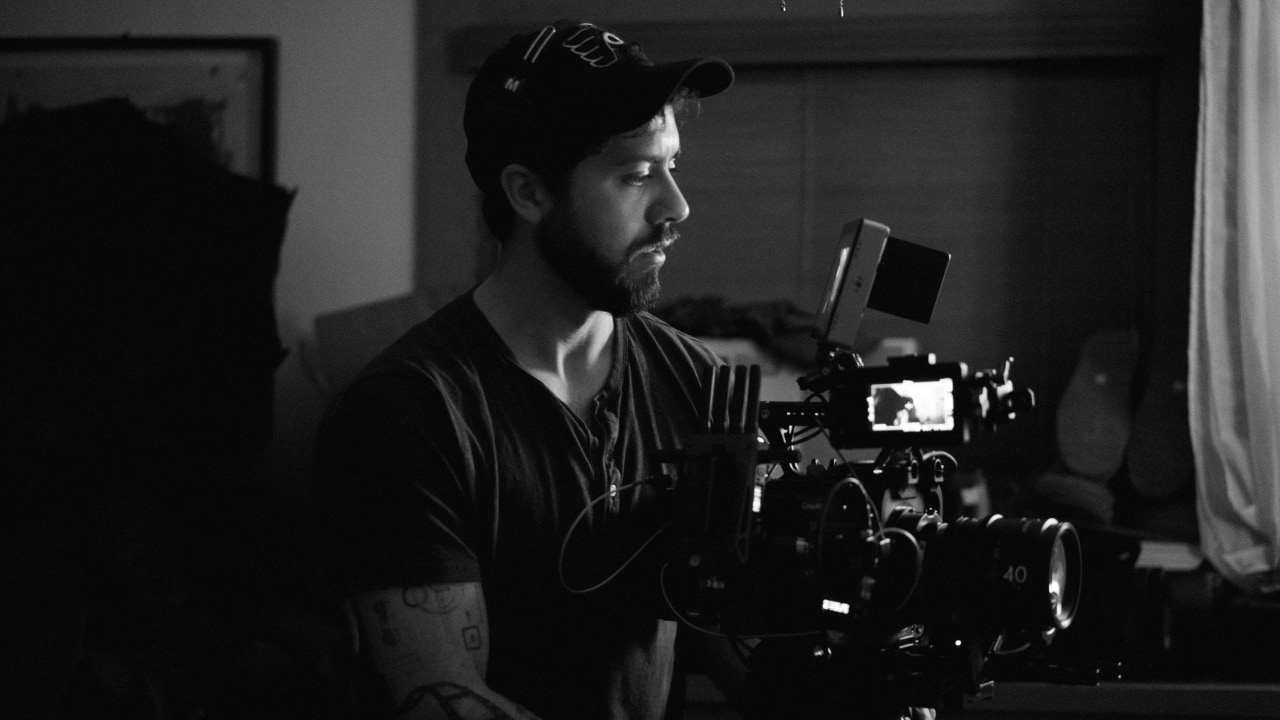
And he happened to mention to me that he had a series coming up involving racing. He didn't even say it was IndyCar at the time. He was like, “Hey, I've got a racing show coming up. Would you be interested in working on that?” And I said, “This is perfect. I just started getting into racing and I feel like I have a general idea of how racing works now, so it's the perfect time to get into a racing show.”
Greg: At that time, what was your closest work parallel in your portfolio?
I don't think I really had too much in this vein. The closest thing would be a combination of some of my other work. I've been working on and off on a surf documentary in Africa as well as random one-off shoots. I did a shoot on the Boston Celtics arena once before a game.
Greg: So how did you then prepare for this once you knew you were going to work on it? Was it with your sim rig driving around all the IndyCar tracks?
It's funny you mentioned that because yeah, for the first St. Pete race I loaded up that track and was sim racing it before we got out there. So when we first got to that track it was kinda trippy. It felt like I knew the place.
Derek’s Current Role
What’s your current role and what does a standard day look like?
I'm the director of photography for the All In: IndyCar series, so I oversee the visuals of the show and make sure that we are capturing it with the style that we set out from the beginning.
We're shooting something that's happening in real life, so we don't have as much leeway with what we create and how we light it, which is a large part of what I do as a cinematographer—you know, with lighting and lens choice and camera choice and framing, composition, things like that.
But you can certainly choose your lenses which bring a certain level of character, you could say, to them. You can choose how you move the camera. You can have a gimbal, a stabilizer, you can put it on your shoulder, you can hold it with your hands, and all of those things bring a different visual feel to the footage.
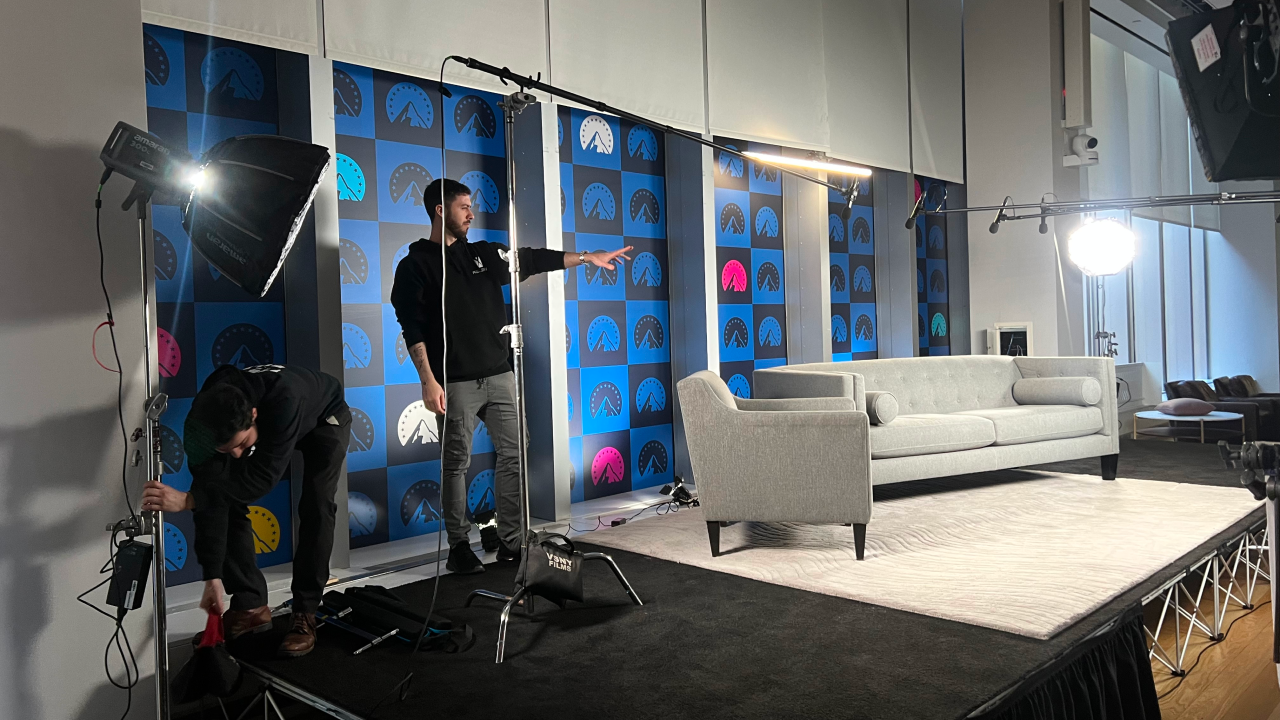
And then for our interviews, we went through a process in the beginning where the director, Matt Maxson, and I sent looks back and forth, references from other interview setups and asked what we thought about each? Do we like this look? What's something that speaks to the All In vibe? How do we want the interviews to feel?
And for those we knew that we were going to be shooting interviews across a lot of different locations, yet we wanted them to look the same. So we came up with a backdrop so that the show had a consistent look across all of the episodes.
Greg: Who's involved in the storyboarding or episode structuring? How much of it is planned versus reactionary?
So the director and showrunner, Matt Maxson, is primarily responsible for that. And so each episode we choose someone to follow—a team or a driver, basically. It's not really dependent on whether we think they're going to win or not. We're not chasing wins, we're just chasing the story of their weekend.
We go into each episode knowing who we're following and the stakes for them up to that race in the season. And then we just have to follow whatever happens that weekend.
It helps us to know what's important when things happen on track. You know, if someone crashes and they've crashed a lot this season, it's yet another hit to their season, you could say. We just know the stakes and then explore them as the weekend goes on.
How would you describe what shooting at races is like compared to other projects you’ve worked on?
It's a lot more fast paced. It's in the hot sun all day. You have to be ready for the elements.
The biggest thing for me was figuring out exactly what equipment would best facilitate what we needed to do. The first couple episodes I probably had too much stuff, too much gear, and I’ve been whittling that down over the course of the season to be exactly what we need for what we're walking into.
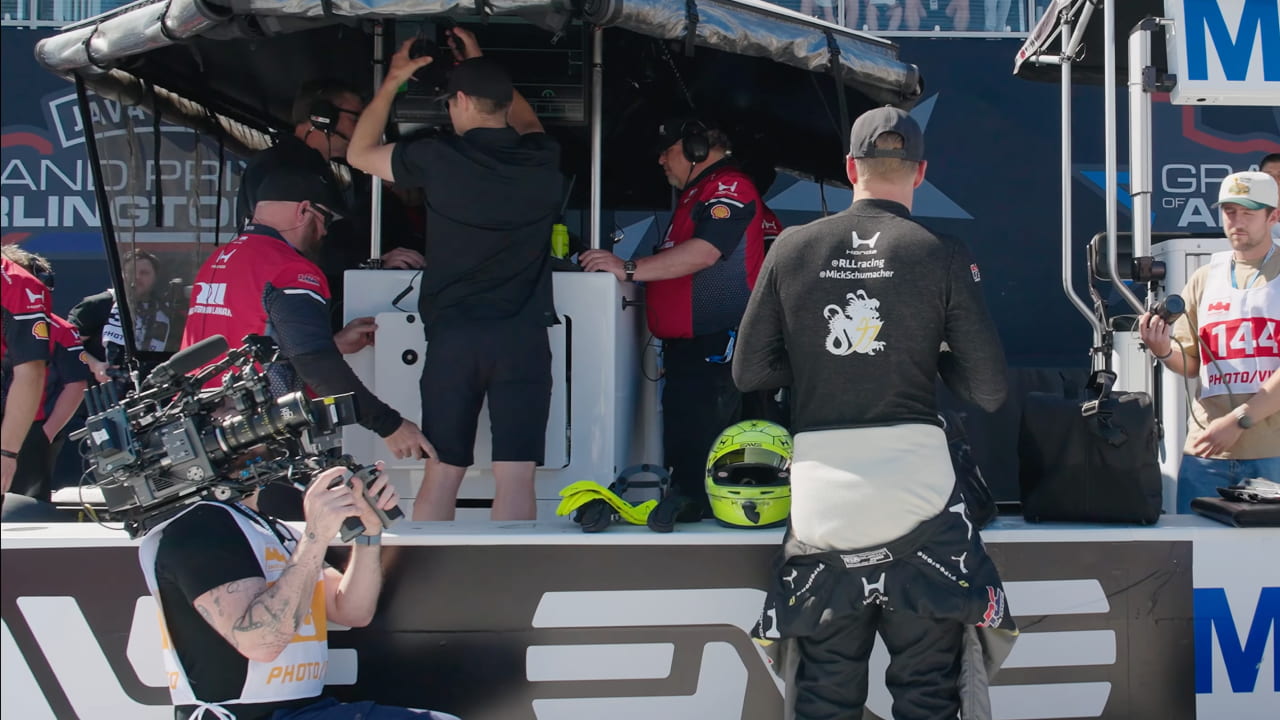
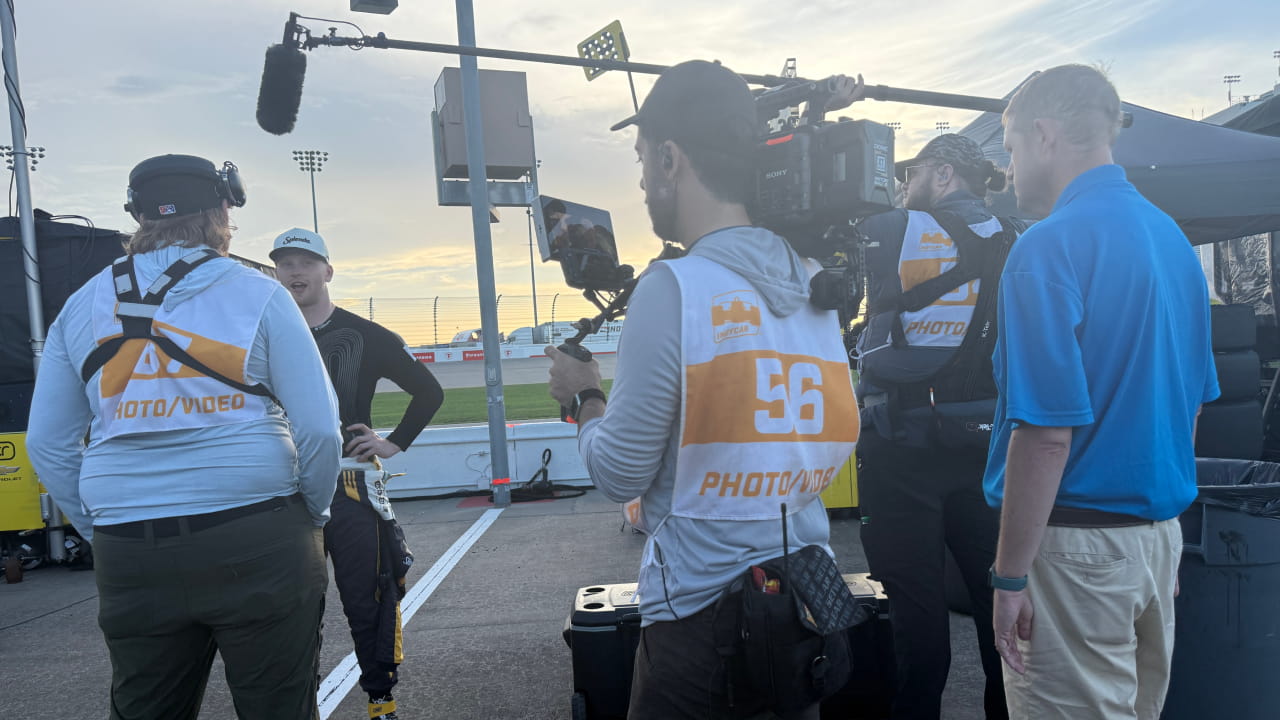
We also have to be really mobile for IndyCar. We have to be ready to go to any part of the track at any time. That means a shoulder rig, extra batteries in like a single backpack. We've got a lens in there. Just being able to take everything with us, hop on a golf cart and go. We have to be self-sufficient. We don't really have any place to leave much stuff on track.
Whereas with my promo interview work for the F1 movie, it was locking down tripods in Manhattan hotel rooms. We had the cast—we had like Brad Pitt and Jerry Bruckheimer and Javier Bardem—just in interview setups. So that wasn't really similar.
We have done a bunch of interviews for All In, but we kind of had to do two different productions for that. There was an interview set up that was at a hotel somewhere, and then we had to have our mobile set up to be able to run to the track. And we'd actually be going back and forth a couple of times, which is difficult, because you have to build the camera in slightly different ways. And our lighting and all that kind of stuff.
The first couple of episodes were a big learning experience, figuring out how being on track works, how the paddock works, the garages. We have full access to be anywhere we want. But there's obviously safety rules and things that you have to pay attention to. So just figuring out what those were and when we could and could not be in the pit lane, and so forth. It was a learning experience. But I've had such a wide variety of previous work that I think I was pretty ready for whatever we were getting ourselves into.
Greg: What surprised you most about the All In: IndyCar project?
How accommodating the teams are.
You know, I always feel like I'm in the way when I'm in the pit lane. I'm walking in between the tires to get up to the wall, climbing over the wall, getting in front of the cars, and the mechanics will actually move around me a lot of the time. And I am like, sorry, I feel like you should tell me to move, but you're just going around me. I'm in their workspace but yet they don't even really blink at that.
In prior work, I've had people saying, “You can't be here. You’ve got to be over there. Get out of the way.” But here, you can just be there and everyone understands the purpose. That's really cool.
What are the most rewarding parts of your role?
It's like getting that perfect shot—the perfect lap. Something that can communicate the story points in a visual image, as well as being in the right place at the right time and getting this great shot. That's really satisfying.
And then seeing the episode come together, be released, and seeing how all of these individual moments that we got, which might be scrambled in your own head when you're there—then to see what Matt Maxson and Ryan [Lohuis, the other showrunner,] piece together out of it is really rewarding.
What are the top 3 qualities that have helped you succeed in your role?
Collaborative
I really enjoy collaboration. That's something that has really helped me, just going into a project and exploring with a director. I try not to bring a lot of my own preconceived ideas into something until I understand what the objective is. And then I like to be able to help with getting us to that objective versus coming into the production and doing what I want. So I kind of try to tailor what I want to the needs of the show.
Resilient
It's not a profession that's easy to stay in long-term because it's a rollercoaster.
There's a lot of work, and then there's nothing for a month or two, and then there's a lot of work and everyone wants to hire you the same weekend. And then you're like, “Why can't we space this out a little bit? Can you schedule your production this week and then you schedule your production this week?” But for whatever reason they're always the same week. You have to be ready to live that lifestyle and try to keep things as level as possible.
Observant
You have to develop your own perspective on things. You have to be able to see something unfolding and then figure out how to capture it in the way that you want to capture it, versus just standing off to the side and getting a wide shot. Anyone can do that. But to stand out and develop your own style of shooting, it's something that you have to work on and develop your eye for.
Greg: It’s interesting because you can’t control the composition, so you have to work in the moment.
A lot of it also comes down to putting yourself in the right position for something to happen. For example, I can't control the lighting on the track, but I can control where I go to film things.
So if I want a pretty backlight, like the sun backlight kind of silhouette shot, I can position myself in such a way that I can get that shot when one of our subjects comes through versus always being with them. I can go ahead of them because I know the driver's going to come out of the garage and go to the paddock or go to the track. So I can go position myself where all the drivers are coming through and find a good angle that I like and then capture our driver coming through that shot.
Derek’s Learnings and Advice from Filming Motorsports
What's something about shooting motorsport you had to learn the hard way?
There have been certain shots that I've wanted to get, but I wasn't able to get them because of either crowds or whatever it may be. So being a little bit more aggressive was something that I learned is very helpful on this type of production. Not to get in anyone else's way, but to just go for the shot that I need to get and put myself where I need to be, unapologetically I guess.
Our first episode that we ever did was on Alex Palou, and he happened to win that race. So we got thrown into the deep end a little bit with going through all those celebrations and how much he got mobbed after that. We were like, “Whoa, we gotta get into this huge mosh pit of people to get our shot.” After that I understand how this goes.
What advice would you give to someone looking to be a cinematographer?
I don't know that I have a whole lot of advice just yet for motorsports in particular, because I'm relatively early on in my own motorsports career, I guess you could say. But I think the general advice that I have for most people is to not wait for permission and just start shooting stuff. No one is going to come in and just give you this job position. It's something that you have to have a body of work to show and to become the go-to person for somebody. And then you grow with them.
So finding an up-and-coming director or an up-and-coming sports journalist or something and shooting content for them and growing with them can really build a valuable partnership for you to break into the thing that you want to break into.
That's something I've done with multiple people in multiple different avenues in the industry, whether that's narrative directing, the people who create these promos and press content that I've been shooting.
Get in with somebody at whatever level and grow with them. Invest in the relationship over time and then that can get you where you want to go.
Fun on the Job
What's a moment from the IndyCar series you're most proud of capturing?
That's a good question. I think in the first episode, finding our way through the Palou madness was really satisfying. To have zero familiarity with what was about to happen and then managing to capture everything the way we did is something that I'm really proud of.
Greg: What do you see when you watch it back?
I'm always really satisfied when I find a way to inject style and character into documentary footage because it's so easy to just do it broadcast-style. Obviously, there's nothing against doing things broadcast-style, but for me, I'm looking for more of an art. I'm looking for a creative approach because we're not doing a broadcast. We have freedom to capture things in a different way.
And a really interesting example of that was in Arlington. There was one moment during sunset where all of the broadcast camera people were lined up trying to fight for this one spot to film the drivers. And me and Tony [Schiavone—the second camera operator—] were both on the opposite side. And no one was really trying to be there because that was where the sun was shining into our lens.
Everyone wanted the sun to be lighting up the drivers' faces, but we were looking for a different kind of shot. We were looking for that artistic silhouette shot because that's the kind of production that we're making. We're not doing television, we're doing a documentary.
What’s in your gear bag when you’re shooting an IndyCar weekend?
A lot of things. We're shooting our A-camera—a Sony BURANO—that’s a really great documentary camera. It has amazing quality and internal neutral density (ND) filters which are a huge, huge help in these crazy all-over-the-place situations to control the light. We also use the Sony FX3.
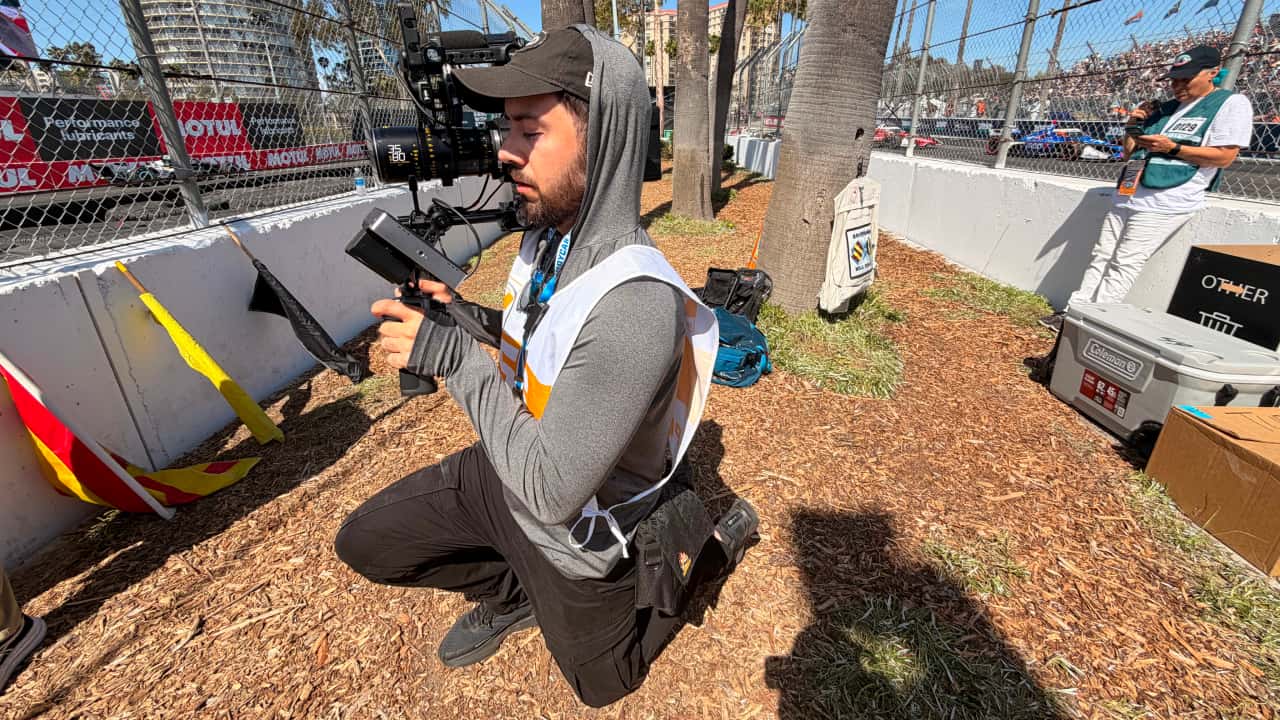
We have our DZO Catta Ace lenses. We felt like they would be a perfect lens for this because they're cinema lenses, so they have a bit nicer characteristics to them. And being zoom lenses, they are flexible enough to find the shot that we need to get on track. The most common lens I use is a 35-80mm. And then I also have a 70-135mm which I use a bit more during the on-track sessions, because that's great for getting the drivers in the car as well as people on the timing stand having conversations. And then I also have a 70-200mm and a 200-600mm.
I've got the shoulder mount and with the two handles I can control the focus and the zoom without having to reach up to the lens.
We've got GoPros. We've got flexible arms to mount the monitors and stuff like that. We've got cables and monopods and usually a gimbal.
For the interview days, they ship the backdrops separately, but I have to bring cases of lighting, tripods, chargers—I have to bring six checked cases on the plane. I also have to check the fold up cart that I use to get it all around with. So that's certainly a production.
Want to learn more about other professionals across motorsport series? Then check out all of our Fast Lane interviews, or jump right into one of these:

.png)
.png)