


Josef Newgarden has two Indy 500 wins and two IndyCar championships, but at what cost?
Most people know Josef Newgarden as the back-to-back Indianapolis 500 winner and two-time IndyCar champion. He’s the face of Team Penske and the first to tell you about the almost impossibly high standard he sets for himself.
But what most people don’t know is that behind the trophies, the cameras, and the Super Bowl commercials, Josef is an introvert who finds being in the public eye almost like a punishment. And while he’s risen to the top of the IndyCar world multiple times, his path there wasn't a smooth ride. It was full of the pressure to perform, over a decade chasing an Indy 500 dream he ultimately mourned, and a spotlight he couldn’t escape.
I sat down with Josef to learn what winning at the absolute highest level actually takes, and what it quietly takes away. But as I reflected on our conversation, I realized his mindset offers a whole new perspective on elite performance and how athletes like him find ways to view the world as big and fun, rather than scary.
Is Josef's ultimate drive about counting trophies, or is it about something deeper? Let’s find out.


Meet Josef Newgarden: Why winning comes with “punishments” [0:00]
Josef Newgarden: It's almost like a punishment, in some ways. It's like you get this gift of winning the race and most of everything that comes afterwards feels like a little bit of a punishment.
Greg: I always wonder what winning at the highest level actually entails, the parts that fans never see.
Josef: Every now and then I would just get hit with a bat by somebody, and I could not predict it.
Greg: So, when the opportunity came to sit down with Josef Newgarden, a driver with two [IndyCar] championships, two Indy 500s, and even his own Super Bowl commercials, I jumped at it, and he taught me some things I wasn't expecting.
Why two BIG Indy 500 wins and IndyCar championships aren’t enough [0:38]
Greg: You have a kid's book and you started it off with a note to your son, Kota. You and your wife said, “May your dreams be big, scary and fun.” So, I want to start with the ‘big’. Obviously, there was the 500 stuff, but your career is more than that. You've had the championships. What is the difference between a championship win and a 500 win for a driver like you?

Josef: You know, I kind of did it in reverse in a lot of ways. I personally had a lot of success before the Indianapolis 500. Multiple championships. We were runner-up three times as well. You know, it would have been nice if we were sitting on five [wins], but we've had a ton of victories and no Indy 500. You know, if you have that kind of storyline, do you have to have the Indianapolis 500 to have a successful career? I think that's a lot of what people ask, and a lot of people in this industry, that's kind of how they market it, that you have to win it if you want to have a successful career. I still don't know that I prescribe to that. You know, [the Indy 500] is such a difficult race to win. A championship is comprised of a full calendar. So if you have something go against you one day or another, you have the ability to make it up or to counteract it. You know, you really can't counteract much on this day if something goes wrong.
If the timing's not right and it doesn't all come together, you're just not going to win the race. But if you look at a truly complete successful career, it's so hard to not weight the championship.
Greg: And now that you've got both, then would you say that your career is complete? Or would you say there's more out there?
Josef: Yes and no. I don't know. I mean, I'm not going to speak for other people. I think from an external standpoint though, if I was to speculate, I think you could say it's successful. Internally, I have different goals with the series, and certainly my own career, so I don't feel full satisfaction, but you'd have to understand me. Like, I just have such crazy, lofty goals that I set. I have an unrealistic bar that I make for anything that I'm doing.
Greg: Well, so when you crossed the line and you had this the second time, obviously, you celebrate, obviously you're in the moment, but right after that, are you waking up the next day and going, all right, on to the next, whatever that is? How did you think about it?
Josef: Not with the 500s. The 500s were so difficult to win, and I was at peace with not winning one. It's just so hard to get it right. You can be the best driver on the day, you can be the best team on the day, and that does not guarantee you a victory, unfortunately. And so, I was at a point, before we won it in ’23, that I was comfortable with the fact that we may never win one. So, then truly realizing it and actually, you know, for it to happen, it just was different than anything else that had happened to me in motorsport. I was truly thankful for it. I was just thankful that it went our way.
Greg: And were the championships different for you?
Josef: Very different. Yeah, you win championships, you go to the next. That's how I always was, up until the 500 wins. It's just, check, what's next on the list?
Indy 500 fame: The double-edged sword for an introvert [3:40]
Greg: I talked to Marcus Ericsson. He was saying how winning is like this double-edged sword. On one hand, you've got this career changing moment, and then on the other hand, there's expectations that are placed on you from that. You've got to show up like a 500 champion because you are a 500 champion. Now that you've done it twice, what is that like from your perspective?
Josef: It's tough to say. I don't think everyone will understand this answer. It depends on who you are. If you're not an introvert, then I think it's great. It must be great. I can't speak. I can only speak for myself that I am an introvert. So, the amount of public facing things that you have to do after the Indianapolis 500 is very tough, if you don't like naturally doing that. It's almost like a punishment in some ways. It's like you get this gift of winning the race, and most of everything that comes afterwards feels like a little bit of a punishment, but you have to understand the reason why. I mean, there are certain parts of it that are incredible, absolutely incredible. They're not a punishment whatsoever. I mean, going through the celebrations, everything that encompasses the Indianapolis 500 win, it is indescribable.

People probably think I love cameras and stuff, but I actually hate them. Like every time I go out somewhere too, on the grid or something, I started making this joke the other day, I was like, I need the clicker that just has the frequency hit, and just, everything shuts down. Like, no one's cameras work. I wish that was the case, but it's not what you think of when you're a kid. That's not why you get into it, but you learn very quickly, that's a lot of what it is.
SCARY expectations: Getting the call from Roger Penske [5:09]
Greg: I went in wondering what winning at the highest level actually costs. And so, I asked Josef about three moments, three that you and I can watch on TV or read about, but that only he's lived. What did they actually give him? And what did they take?
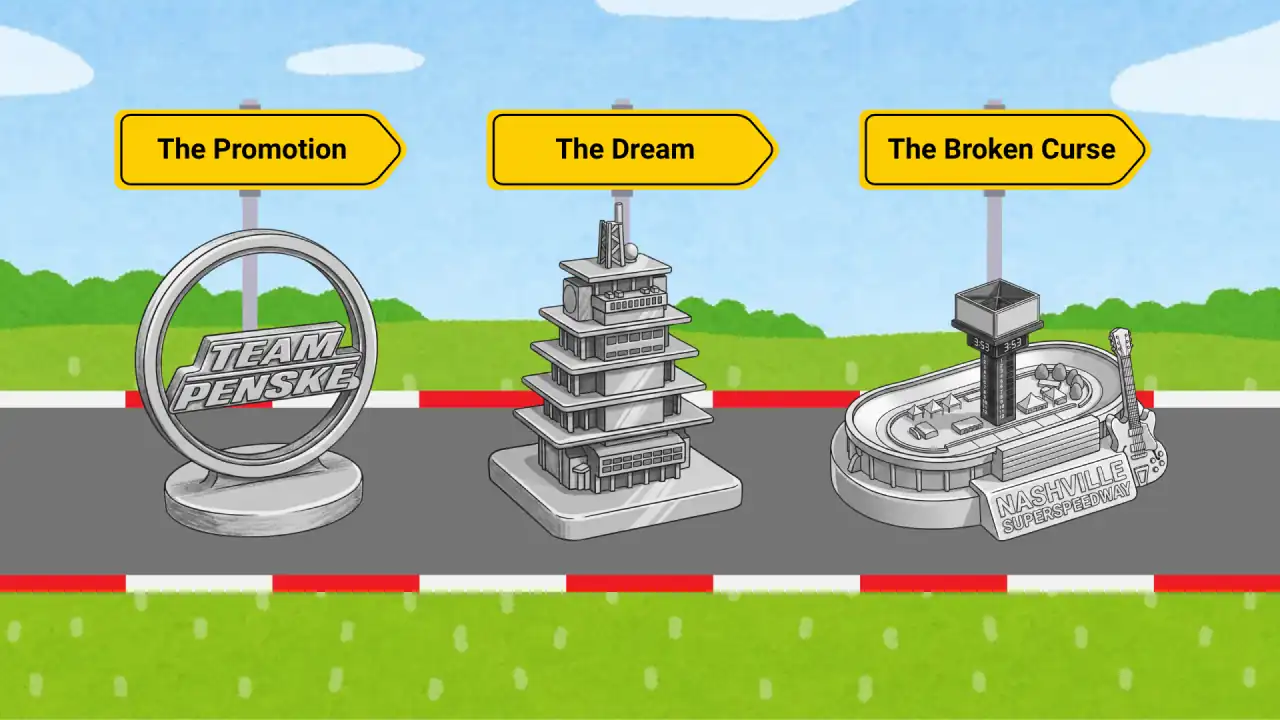
And for that, there was no better place to start than the one that we can probably relate to most: the career-defining promotion.
You joined Team Penske very early in your career. That's another big milestone. When you got the call from Roger saying, “Hey, let's go.” How did that feel? How did that change your trajectory?
Josef: You know, when you get an opportunity to drive for Team Penske, it's one of those things you think about… I thought about it after the fact. I never really envisioned myself driving for Team Penske. I never thought I would have that opportunity. And so, when you get it, you grab it with both hands and you take the most of it. And I just remember being really excited about getting that potential around me. I knew I was stepping into a race-winning team, that we would have race-winning cars and race-winning crews every single weekend we showed up. And there's a pressure with that. Some people fold under that pressure, where you've got to live up to this expectation, you better perform. You're not going to keep that seat unless you perform. It wasn't a pressure to me, it was more of a boost.
Greg: Were you ever nervous about it? Or did you look at it and, like you said, because you have these resources available and you know it's going to be hard no matter what, say, “Let's just go”?
Josef: Yeah, it's more of the latter. I mean, you're nervous… How can you not be nervous in any situation? I think even today, I get nervous all the time, but you have to encourage the nerves in some way, you have to be comfortable with them. It was the same thing with the Penske deal. There were nerves to it, but that's not what I was immediately worried about. I was more encouraged and excited about what I was going to have around me.
Josef’s secret to surviving an 11-year Indy 500 drought [6:54]
Greg: Even with Penske's backing, Josef only came as close to winning his dream race as the podium. From 21 to 32, he tried and tried and tried, the doubt creeping in more and more each time. But somehow, he drowned it out.
No matter what you're doing, right, even when you won the championships, you didn't bat a thousand to get to that point. So, when you're going through that and you've got these ups and downs, how do you, Josef, as a person, manage that? What's your regimen, your way to be in the right headspace?
Josef: That's right. I've had so many years of this that I've changed over 15 years. Everybody does. You grow up and you go through different experiences, and certainly for myself, I've gone through a lot of different experiences. But probably, the common thread throughout is that, Roger always talks about this, that you've always got to look forward, look through the windshield, never look through the rearview mirror. There's kind of a presence to that. There's a methodology to, you cannot sit, you can't dwell. You just got to constantly be, kind of, one foot in front of the other, just moving forward. I think that's true with anything in life. You know, you just can't sit around and wait for stuff to happen.
No one finds success that way. Very rarely do you hear about a story that just falls in somebody's lap. Okay. Sure, it's possible, but whatever you're doing in life, you've got to be going after it. You've just got to find a way to put one foot in front of the other. It's the simplest way to put it, and keep working towards the next goal.
Greg: So, for me, whenever these bad days happen, I'll try and get sleep. I'll try and get a workout in, whatever it may be. What, for you, is that reset? Is it going for a run? Is it just spending time with family? What is that thing that you lean on to then get that forward momentum again and just keep looking ahead?
Josef: I'm a little different, probably, than most, but my reset is my alone time. And for me, I sort of built this internal, you know, this kind of shell where I can internalize myself, and that's where I draw my energy. It's where I re-energize myself, is my peace, my solitude. And I was always that way. I was that way when I was young. I was kind of just a loner in a lot of respects. I wanted to be alone, and it really is introverted stuff. I don't gain energy by being around people, I actually gain energy by being away from them.
So, that's true to this day. When anything bad's happening, I just, I need my peace and alone time, and then I can come back and I can get back in the fight.
Greg: So, I do that, and it's video games or the other things I described. What is it for you?
Josef: It used to be just movies. I was a big movie buff. I was 17 racing in England, and I would just go buy DVDs all the time. This was back in 2008, 2009. So, it was more normal to buy DVDs back then.
Greg: It was last week. (Jokingly)
Josef: Yeah, exactly.
Greg: Blockbuster's like, “He's our best customer.”
Josef: Yeah, I was. I was a great customer. I would just watch movies all the time. Because you can kind of, to me, you could escape in them. You're taking your mind off. I mean, it's a form of relaxation, if you will, and it always was for me. So, that's sort of… I still do this to this day. You know, I'll watch TV shows or movies and just kind of dive into that.
A year to forget: How Josef moved on from the 2025 IndyCar season [10:02]
Greg: If winning that first 500 was like surviving a marathon of defeats, then making it to the end of his 2025 season was like surviving an all-out sprint of them. By the season finale, he was 0 for 16, five races ended in DNFs, and Penske was plagued with cheating allegations that led to firings, fines, and penalties. Then came Nashville. I was there for that final race when he won, and I thought after everything he'd been through, it would have changed his mindset. Boy, was I wrong.
That was the final race of the season. You broke the streak and you won. In that moment, what was going through your head?
Josef: I was happy the year was over, more than anything. Pretty much, nothing really went through my mind other than that. It was a very bizarre ’25. It was like, you just... I would walk around the corner and it was like, every now and then I would just get hit with a bat by somebody, and I could not predict it. And it just seemed like every race you're like, okay, what am I going to find around this corner? Like, I almost don't want to walk around it.
.webp)
Nashville was not one of those days. Nothing weird happened. No bat to the face, and I was just kind of happy that that was that. It was like, all right, cool. We got that done. There was really no joy with it, whatsoever. It wasn't like, oh, wait, you won a race. It was like, dude, we won so many. And that sounds silly to say, but it's very true. I mean, what's another win? When you win 30 plus races, what's another win? It was like, nothing bizarre happened today, we got a win. Doesn't change anything. It's not like, oh, wow, now I'm super happy because we got a win for the year. It just didn't matter. I was ready for the year to be over.
So, I was happy for the day, and that's still a victory for the team. There's all those little things that go into it, but other than that, it was more just like, all right, I'll see you later, I'm going to take off now. But yeah, it was kind of good. It was just like, let's close the book. The book was over, and I didn't want to read anymore.
Greg: Fair enough.
Finding the FUN: What actually fulfills a champion [11:53]
Greg: If trophies aren't the “big” wins he's counting, and the “scary” bits are the cost of doing business, what is it that Josef's motivated by? What's the “fun” that keeps his glass half full?

Josef: My bliss is getting to work with the people around me. It really is. It's not just a cheesy answer. I take so much fulfillment in the process, and I've done a lot of thinking on this. I'm crazy—I'm crazy competitive. I want so many results and I want them more than anybody. And there—there's a huge list, but the result is not the fulfillment anymore. It's just the process and the effort that goes into it. When you first start and you start racing karts, you're like; man, I love getting in and driving the vehicle to the limit. You know, I'm fast or I'm fast in this corner and I'm not fast here, but I'm going to figure it out.
It's the same thing with the Indy 500. I'd love to win five of these, but if we don't win the race, well, what am I going to take away from the weekend? Because you either just take that terrible defeat and that demoralizing feeling, or you take something else from it. And nowadays, I really lean into the effort of it. And so, that fulfills me, and it's what I show up for still.
Greg: Over the years in the paddock, I've seen Josef's fulfillment firsthand, just in different places, like his book readings and his fundraisers.
I want to ask you about the [Newgarden Family Foundation]. With everything you have going on, all the other things, why was this the right time to start something like that and have this fulfilling chapter of your life?
Josef: I got introduced to this charity, SeriousFun Children's Network, and I learned about Paul Newman and the reason he started it, and it's really impactful to me. I mean, even before I had kids, I just thought, “Wow, you know, being a kid should be just a fun time in your life.” Not everything should have to be so serious when you're a kid. I have to remind myself of that now with my sons, because I'm a tough parent, but my wife's like, “They're just kids.” And she's right, and being a kid, you should have the luxury. I would want every kid in the world to have the luxury of just being a kid.
So, we started with the ping pong tournament. Did pretty well. We had tons of sponsors that kept putting cash in directly. And this will all just go directly to SeriousFun Children's Network. And so, then you fast forward, it was like, well, why don't we try and make something more robust? Let's start a foundation. We can support SeriousFun Children's Network, we can support other charities that we care about. And as we build the thing out in the future, it's like, how do we get every dollar to go to work where it should?
The biggest lesson Josef Newgarden wants to teach his kids [14:20]
Greg: You grew up in Nashville. You started all this with your dad and you're making your way. Now you've got your kids. What from this “big, scary, fun” journey, what lesson do you want them to take away from this, and the fact that you guys can share all of this together?
Josef: One of the great things I was given, a gift from my parents, is that you can pursue anything in this world. And you really can. I mean, that's a true statement. It doesn't matter who you are or where you're from or what you look like. You can really pursue anything that you want to. You've got to be a problem solver. You've got to be a believer. You've got to be a go-getter. And I got that from my dad. I don't come from a racing background and we didn't come from a blank check. I mean, I had resources, for sure. I mean, my story is different than everybody else's. We had resources to start with, but it doesn't mean we had everything in place to work up the racing ladder, become a professional race car driver, but there was a will and there was a way, and we kept just going. Like I was telling you, we kept putting one foot in front of the other. A lot of that was driven by my father. So, I want my sons to kind of have that belief system in place.
You have to really be passionate and believe in something, and you have to find passion in something, and it has to be self-fulfilling. I don't want my sons to grow up and do things for our pleasure, their parents, or for other people. I want them to be fulfilled for themselves and what they're doing and to feel really good about it. That's probably the most basic principle that I would want for my sons. And they don't have to be race car drivers. They can find whatever they want. If they want to pursue that, then I'm not going to stop them because I know how much I liked it, but it doesn't have to be race car driving.
Greg: Josef finding fulfillment was a powerful message, and it's a great reminder that even winners have bad days. Who knows? You might be having one right now. The question is how you and I act like Josef and keep putting one foot in front of the other, so that we make sure every moment feels big and fun, no matter how scary.
Want more exclusive Insiders?
Then you're in the right place! Head to our YouTube playlist for more, and be sure to subscribe to be the first to see new episodes. Or you can check out some of our recent episodes below:


.png)
.png)