


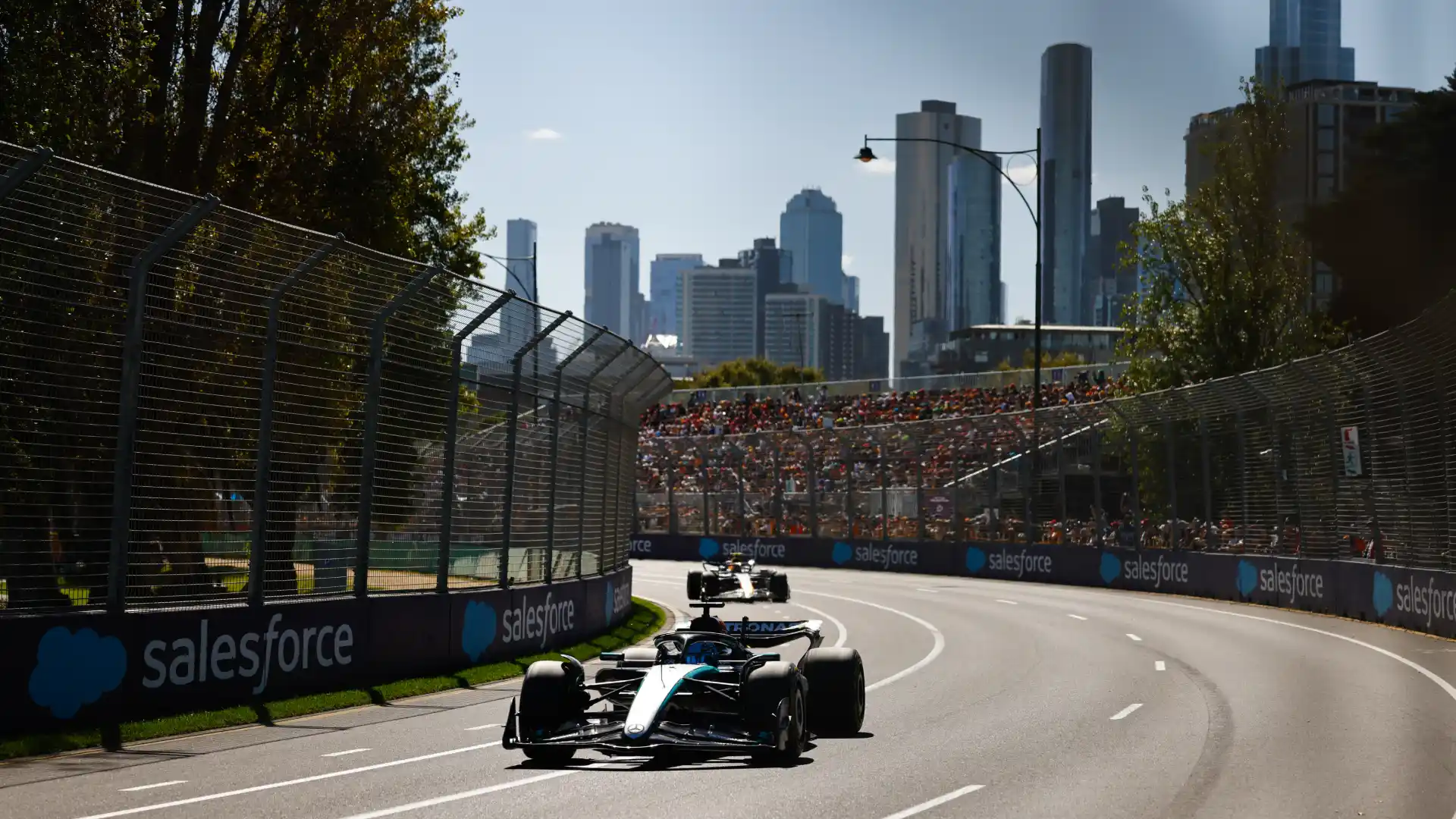


At long last, the Formula 1 off-season is over and we are in the first race week of 2026! With the Australian Grand Prix just days away, we’re here to get you in racing shape by sharing our favorite wild facts and iconic moments from down under.


The Australian Grand Prix is older than F1 itself
In fact, this race is almost coming up on its 100th birthday! The very first ‘Australian Grand Prix’ was a road race organized by the Victorian Light Car Club on the Phillip Island Grand Prix Circuit back in 1928. The track at the time was roughly rectangular, with four right-hand turns–think like an early variant of oval racing, which was gaining popularity in motorsport at that time.
Bugatti dominated the early days of the Australian Grand Prix, with five consecutive wins between 1929 and 1933. The first came on the wheels of Arthur Terdich in a type 37A Grand Prix Bugatti two-seater, and reached a top speed of 110 mph (177 km/h). It may have felt super-sonic back in the day, but it’s nothing compared to modern Formula 1. Just last year, Alex Albon clocked 226 mph (364 km/h) at Monza.
Since then, various motorsport events called the Australian Grand Prix have been held on over 20 tracks across Australia. The first Aussie F1 race took place in 1985, on the Adelaide Street Circuit, and it wasn’t until 1996 that it moved to the Albert Park Circuit, in Melbourne, where it has been held ever since.
David Coulthard broke Martin Brundle’s car in two
If there was ever an incident in F1 that would leave your jaw on the ground, it’s the opening lap of the 1996 Australian Grand Prix.
Going through Turn 3, David Coulthard's McLaren slid to the left side of the track, right in the line of an accelerating Martin Brundle. Brundle’s Jordan Peugeot hit the rear of Coulthard’s car head-on, and was catapulted into the air, over the McLaren (friendly reminder, F1 cars didn’t have a halo back then), through the gravel and, finally, into a wall where it broke in two. The accident was so extreme that the race was stopped to make sure all drivers were safe and to clear the track from the debris.
Yet despite the state of his car, Brundle himself was thankfully unhurt. In fact, he got out of the heap of metal and waved to the crowd before hopping over a nearby fence and running to the Jordan garage to get his spare car and rejoin the race when it resumed (a unique feature from this era of F1).
Unfortunately, it was not his day, as he had a lock-up and another–albeit much smaller–collision on Turn 3 of the restart, this time with Pedro Diniz of Ligier, forcing him to retire from the race completely.
Coulthard, too, retired on the 24th lap after mechanical problems with his car.
The first race to ever have three red flags
The 2023 Australian Grand Prix was the first race in F1 history to record three red flags, and to this day still holds the record for most red flags during a single race.

The first red flag came out relatively early, on lap eight of 58, after Alex Albon spun out into the gravel through Turn 7, sending debris across the track that needed clearing before safe racing could continue.
The second flag didn’t come until much later in the race, on lap 56. This time it was caused by Kevin Magnussen, who clipped the wall at Turn 2, causing his right rear tire of his Haas to fly off and onto the middle of the track. This and the surrounding debris was enough for the marshals to call for a red flag.
And with just two laps to go, one might think there isn’t enough time for a third red flag before the race finished. Yet F1 is a sport full of surprises, and indeed, a third red flag flew as carnage ensued on the race restart, with Carlos Sainz making contact with Fernando Alonso, the Alpines of Pierre Gasly and Esteban Ocon colliding, and Nyck de Vries, Logan Sargeant and Lance Stroll all winding up in the gravel within the first few turns.
And that wasn’t even all that happened during that race, as three drivers retired (Albon after his incident, Charles Leclerc who got beached on the first lap, and George Russell, who had an engine failure earlier in the race). All in all, only 12 truly crossed the finish line at the end of lap 58 in what will be remembered as one of the most chaotic (and red) races in recent history.
Bonus: One of the shortest F1 races ever
The 1991 Australian Grand Prix was to be the finale of the season. Ayrton Senna secured the Drivers’ Title during the previous race in Japan, but McLaren and Williams were still fighting for the Constructors’.
While the weather was calm and sunny during both practice and qualifying, the opposite was true for the race itself. The morning saw torrential rain, and the race start was quickly derailed as yellow flags soared and driver after driver spun off track or collided with a fellow competitor. In the end, the Grand Prix ended after just 14 officially recorded laps (Senna got up to lap 17, but the officials called for a count-back due to several stoppages early in the race) and only 33 miles (53 km) of the intended 190 miles (306 km) completed. Senna was first among the finishers, scoring the Constructors’ Title for McLaren that year.
This remained the shortest race in F1 history until quite recently, when similarly extreme weather forced the 2021 Belgian Grand Prix to be cut off after just three laps (one racing and two under Safety Car) around the Circuit de Spa-Francorchamps.
Cover image via Mercedes-Benz Media.



.png)
.png)