


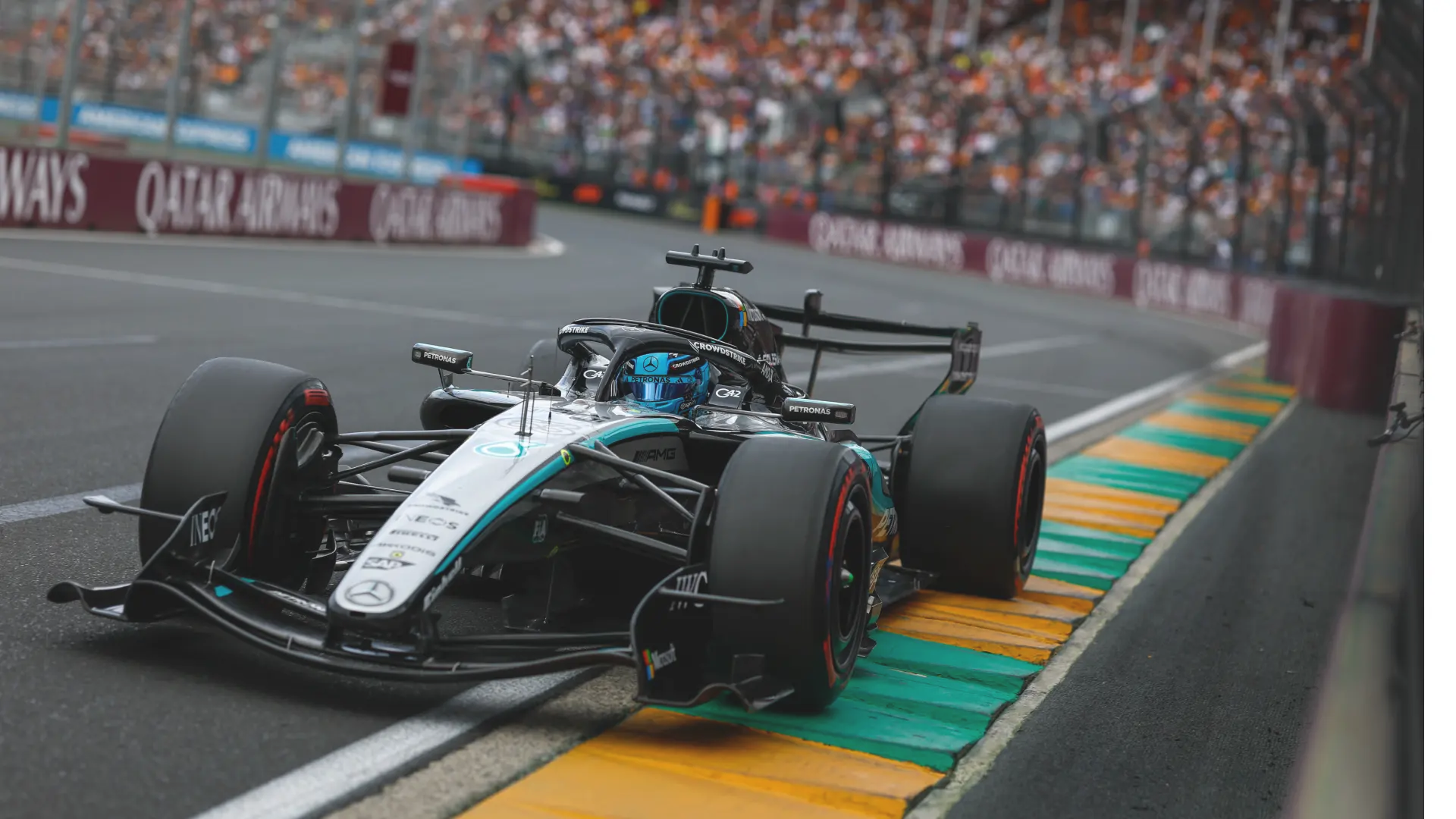


Super-clipping. We all heard the term throughout Formula 1 pre-season testing in Bahrain, and we heard it during the Australian Grand Prix… but what exactly is it?
Don’t worry because we’ve got you covered with a full breakdown on how super-clipping works and why teams are using it.


What is super-clipping?
You may have noticed that instead of accelerating in the second half of a long straight or through high-speed corners like we’re used to seeing them, F1 cars have been slowing down. This is the tell-tale sign of super-clipping.
The decrease in speed happens because the Motor Generator Unit, Kinetic, (MGU-K)–the power unit component responsible for charging and deploying the battery–switches from powering the axle of the rear wheels and accelerating the car to harvesting electrical energy. With less power going to the wheels and more to the battery, the car slows down even though the driver stays at full throttle the entire time.
Why does super-clipping happen?
Super-clipping is a side-effect of the new hybrid era of F1 that we are in.
With the cars now relying on roughly 50/50 power from fuel and electricity, and the extremely high demand on the battery, teams are constantly looking for ways to manage the amount of electrical power they have available.
One way of energy management is lifting and coasting (LiCo), in which the driver lifts off the throttle a few meters early and ‘coasts’ before braking. Many F1 fans are familiar with LiCo as a means of conserving fuel and tires, particularly in hard braking zones like the end of a straight, but in this new era of F1 it is also becoming a key form of battery charging, with up to 350 kW of energy recovered during the process.
Super-clipping is another tool for doing exactly this. In contrast to LiCo, cars can only recharge up to 250 kW while super-clipping, but it does have one big benefit that may outweigh the difference in power harvested: it charges the batteries while the driver is still at full throttle.
The big reason teams are using super-clipping so much
That last detail–the throttle–is the reason why this technique has become incredibly popular throughout the beginning of the 2026 F1 season.
During super-clipping the driver is still going flat out, meaning that the active aerodynamics on an F1 car stay in straight mode, with the front and rear wings in an open configuration. In LiCo, on the other hand, the driver comes off the throttle, and the wings close, going into cornering mode.
But staying in straight mode means that, during super-clipping, there is far less downforce on the car. So when you’re pitching down a long straight, your car stays as fast as possible even with the diversion of energy from the rear wheels to the battery, ultimately keeping your lap times to a minimum.
So while cars may be slowing down at the end of a straight, this isn’t necessarily a sign of poor performance, but a result of drivers managing their batteries. With the current F1 regulations forcing teams to strategize around energy deployment and recovery, tools like super-clipping are becoming a key means of balancing the tradeoff between outright speed and energy harvesting.
Cover image via Mercedes-Benz Media
.jpg)

%20(1).jpg)


.jpg)
.jpg)
.png)
.png)