


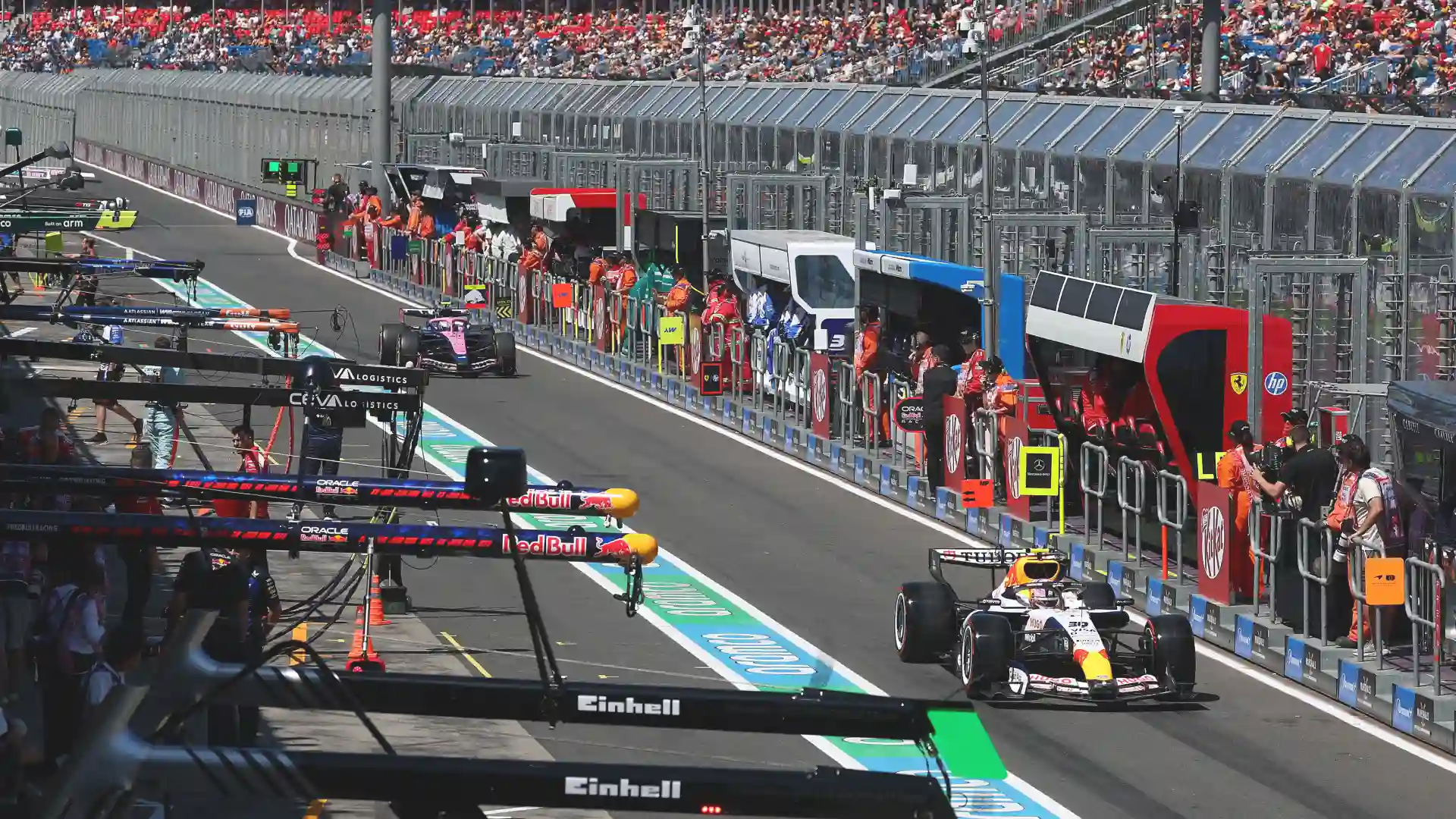


Formula 1 may often feel like a travelling circus, but it is less like relocating a few dancing lions and more like airlifting the entire San Diego Zoo to a new country every week. In 2026, all F1 teams will be heading to 21 countries around the world, each bringing with them up to 50 tons of equipment. That’s enough to fill up six Boeing 747 jets… per team! And with 11 teams on the grid this year, that means at least 66 jets-worth of cargo needs to be shipped off to each of the 24 races on the calendar.
But F1 is nothing if not a hub for clever strategy and using every resource available to get as much speed and efficiency as possible, and the logistics department is the perfect example.


What is multimodal transport?
Instead of sticking to one means of transport, F1 leverages multimodal transportation by combining three different methods: sea, air and land. Having multiple options, frequently used in combination with each other, ensures that everything makes it to the right track at the right time, while staying both efficient and sustainable. This is thanks to F1’s partnerships with logistics companies such as DHL and RPM, which provide fleets of ships, airplanes and trucks to guarantee the safe delivery of all cargo.
Yet effectively using multimodal transport is no easy feat, and coordinating everything often means that teams are busy planning departures and schedules up to a year in advance. This is because choosing a shipment method depends on what exactly is being shipped by the teams, the locations of the races it is being shipped to or from, and when it needs to arrive.
So let’s take a closer look at each one of these transport methods, and how F1 teams might use them throughout the race calendar.
Sea freight is ideal for shipping infrastructure
Shipping equipment by sea is by far the most cost-effective option for F1 teams. According to Aston Martin Head of Race and Trackside Logistics Franco Massaro, shipping just over one ton (1000 kg) of equipment by sea saves the team over $290,000 (£250,000) per year compared to other methods. And when you need to move 50 tons of equipment internationally every other week, sending as much as you can by sea really does help cut down on the logistics costs.
It is also one of the most sustainable transport options, helping F1 teams–and the sport as a whole–move towards their goal of net zero carbon emissions by 2030.
That said, it is also the slowest, with cargo often taking up to five weeks to arrive at its destination. And with teams often aiming for this type of shipment to be delivered about 10 days ahead of a race, timing is affected all the more. For example, for the 2025 Australian Grand Prix, teams were sending their cargo by sea from Qatar to Australia 42 days ahead of lights out.
These extended travel times impact both what gets shipped by sea, and how it is organized. Teams tend to use this for transporting heavier and bulkier equipment that is not essential to racing, which includes infrastructural components for garages, fan zones, hospitality and so on.
They will also typically rely on five or six sets of identical containers, each ‘leapfrogging’ to various locations on the F1 calendar. For example, one might go from the Chinese Grand Prix to the US for the Miami Grand Prix, while another goes from the Japanese Grand Prix to Baku for the Azerbaijan Grand Prix.
Air freight ensures critical equipment arrives quickly
In contrast to sea freight, air freight is significantly faster, making it ideal for shipping equipment with shorter turnaround times. Teams send their cargo by air to Melbourne, for instance, just ten days ahead of the Australian Grand Prix, with the aim of it arriving by the Monday of the race week.
This speed makes air freight one of the most relied upon means of transport in F1 with its main purpose being to ensure that race-critical equipment arrives on time. Everything from broadcast equipment and critical IT components to power units and even the cars themselves are all delivered to their destinations by plane.
Keeping things as eco-friendly as possible is the use of Sustainable Aviation Fuels (SAF), which can reduce greenhouse gas emissions by up to 80%. Since 2024, F1 has implemented DHL’s GoGreen Plus Service, which relies on SAFs to power its Boeing 777 Freighters, on about one fifth of its cargo flights to race locations outside of Europe.
Yet despite the efficiency of shipping by air and the careful planning that goes into each step of the way, external situations can always have an impact on the way F1 logistics unfold. The evolving crisis in the Middle East is one such situation. With most F1 teams based in Europe and pre-season testing taking place in Bahrain, the Middle East is a common transit hub ahead of the season opener in Australia. Luckily, shipments of F1 equipment by both sea and air were largely unaffected by the recent developments in this part of the world, but it is not out of the question that future shipments will be impacted and new arrangements will have to be made.

Road freight rules on European streets
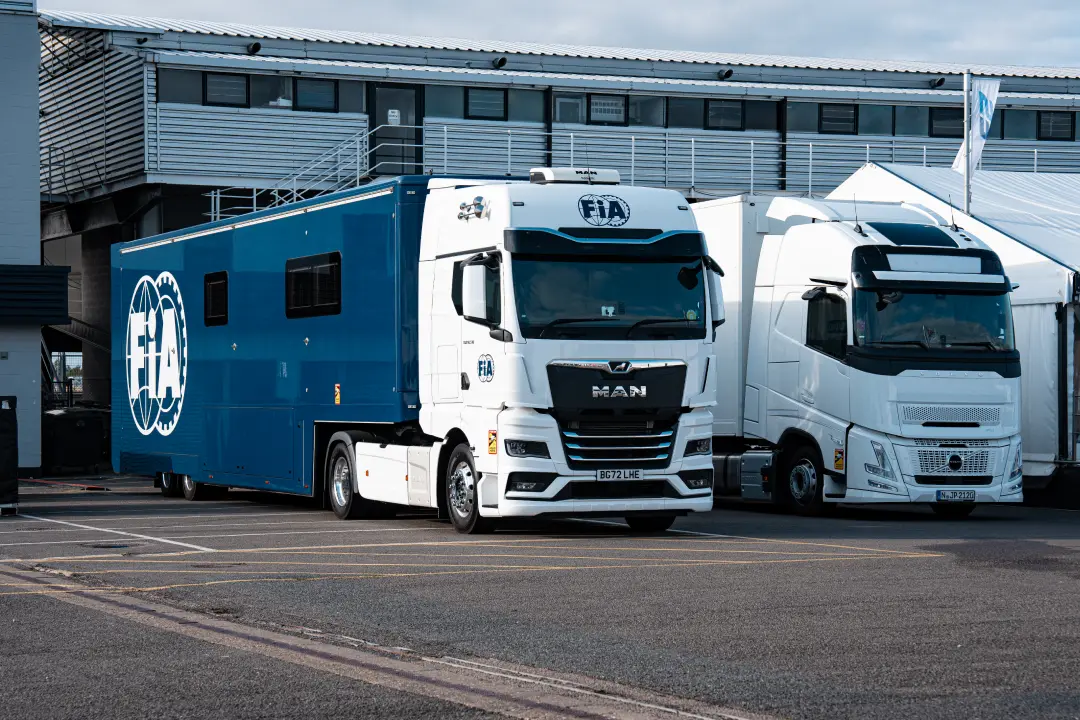
One of the biggest ways that F1 equipment gets to and from various circuits, especially for the European leg of the race calendar, is by freight trucks. At any given point, as many as 400 trucks can be on the roads, each with at least two drivers on-board to ensure that shipments are constantly on the move and delivery to each track remains time-efficient.
This is also one of the most versatile means of transport available, as both infrastructure and race-critical equipment can be delivered by land. Infrastructural components are typically carried by trucks belonging to logistics companies; DHL, for example, supplies a fleet of 51 trucks for this purpose throughout the European set of races. Trucks owned by the teams, on the other hand, are preferred for carrying everything that is essential for the race itself. And with most F1 teams being based in Europe–including even the American outfit Cadillac, which has a base in Silverstone–equipment can be driven from factories to race tracks directly, making logistics a little more straightforward at least for this portion of the calendar.
Sustainability also plays a major role in the way that land-based transport is carried out in F1. While it is used in tandem with sea and air transport on other continents, F1 teams ship their equipment across Europe exclusively by land. What’s more, the trucks supplied by DHL are all powered by biofuels, which reduce greenhouse gas emissions by up to 83% compared to standard diesel.
How F1 teams use all three methods together
Road freights may rule on the streets of Europe, but the reality is that without all three transport methods, F1 could not be the global phenomenon that it is today. Each team relies on shipping by sea, air and land year-round to ensure that they have everything they need at all 24 races of the season.
“We currently have about 44 shipping containers of sea freight, 35 tons of air freight, and four trucks that we send to every grand prix,” explained Red Bull Race Team Logistics Manager, Mark Willis.
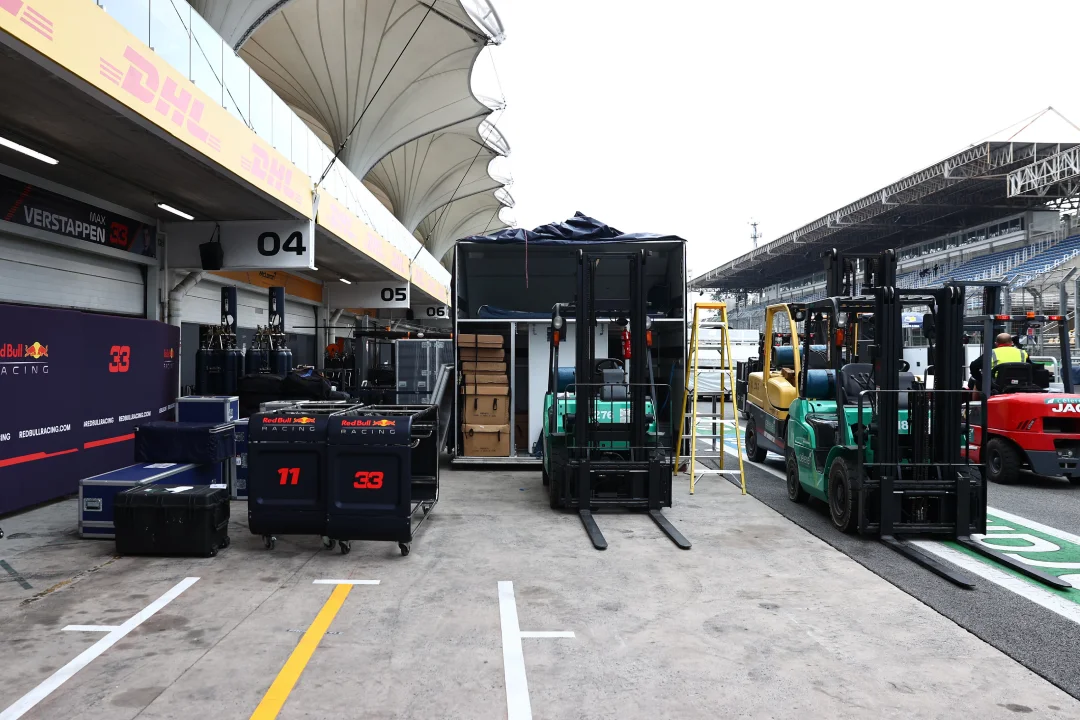
Coordinating all of this is no easy task, as the race calendar demands complex scheduling of what gets sent where. For instance, once the Australian Grand Prix is over, freight containers full of car components, critical electronics and other key racing equipment will be loaded onto cargo planes and flown to Shanghai for the Chinese Grand Prix. At the same time, garage and fan zone infrastructure will be shipped by sea around the world, including to Europe, Singapore, Canada and even Long Beach on the West Coast of the United States where a three-day journey by land takes it to the other side of the country for the start of the Miami Grand Prix.
Regionalization of the calendar has made things a bit easier to organize, however. As of 2023, the Japanese Grand Prix has shifted to April, as opposed to its traditional fall timeslot of September or October, to coincide with other races in that part of the world, such as the Australian, Chinese and Bahrain Grands Prix. Canada likewise has moved to May; it now follows the Miami Grand Prix and leaves the European leg of the schedule uninterrupted.
Adjustments like these not only allow for more flexibility when planning the logistics of F1, they also make the sport more sustainable by making eco-friendly options more practical to use. It is, after all, a lot easier to rely on biofuel-powered trucks when race locations are a few days’ drive apart, as opposed to on opposite ends of continents. F1 is also always looking to expand its transport options, and has been discussing adding railway freight in the near future.
All in all, F1 logistics often feel like an entirely separate sport running alongside the Drivers’ and Constructors’ Championships. But with a bit of teamwork from key partners like DHL and smart integration of multiple strategies, every bit of equipment in the F1 zoo eventually makes it across the finish line time and time again.
Cover image via Red Bull Media Centre


.jpg)





%20(1).jpg)
.png)
.png)