





The Basics
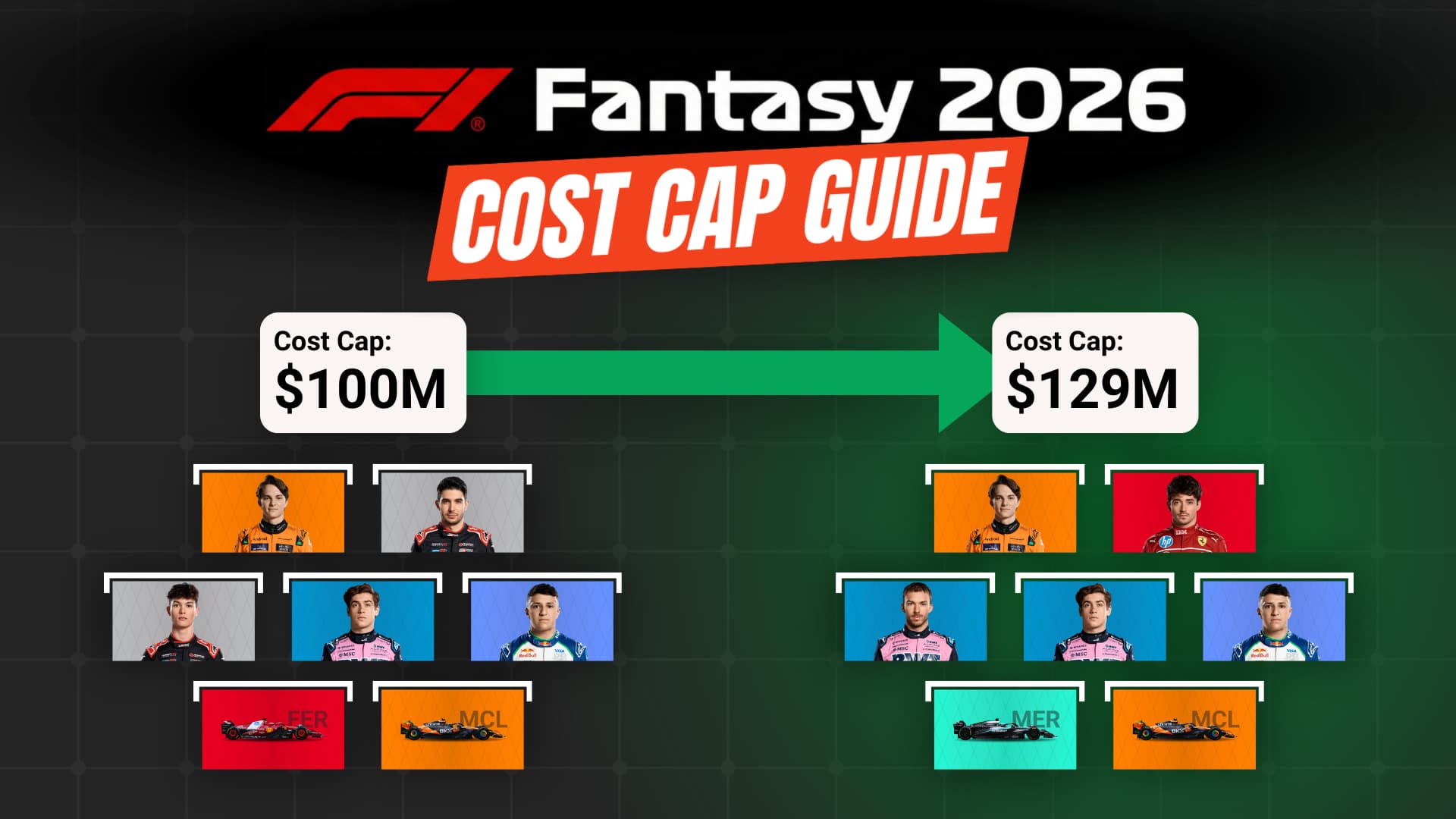
Each new team starts with a $100M cost cap to select a team of five drivers and two constructors. The game updates the values of all assets after each race based on performance — drivers and constructors can gain or lose value. For example, if a driver finishes P2, wins Driver of the Day, and records the Fastest Lap, they likely scored enough points to earn a price increase. On the other hand, if a driver finished with a negative score, their price probably decreased.


In the example above, let's assume the driver's value increased by $1.0M after that strong performance. The cost cap for teams that selected this driver also increases from $100M to $101M, giving them more buying power moving forward. By the end of the season, top teams can build over $30M in value and afford multiple top drivers and constructors such as this team below:
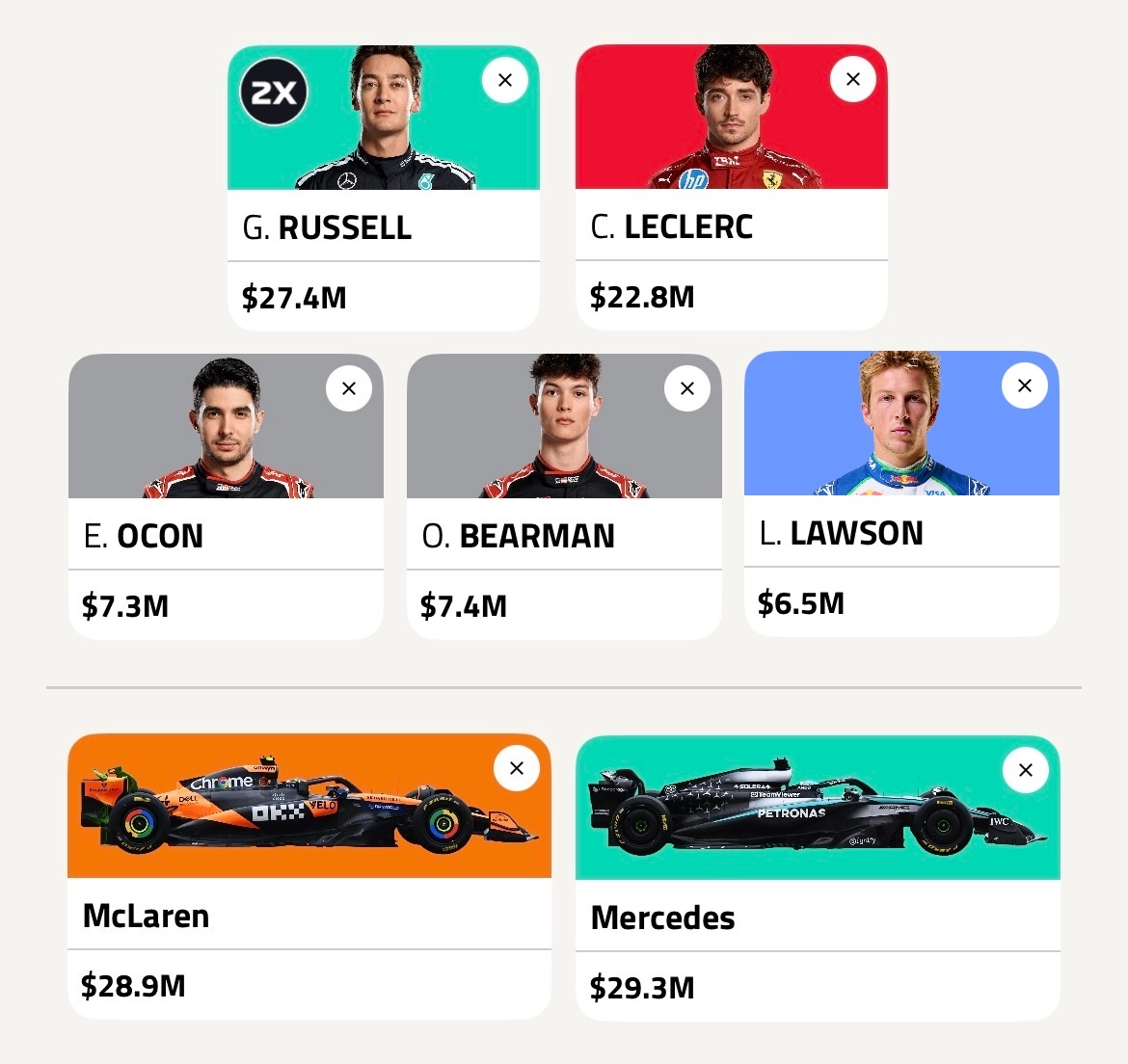
With that advantage in mind, growing our team's cost cap unlocks the ability to bring in higher quality drivers later in the season and provides a competitive advantage. So how are price changes calculated so we can spot the best values?
Pricing Tiers and Price Deltas
All drivers and constructors fall into two pricing tiers:
- Tier A: Greater than $18.5M
- Tier B: Less than $18.5M
The two tiers undergo different price changes:
- Tier A: -$0.3M, -$0.1M, $0.1M, $0.3M
- Tier B: -$0.6M, -$0.2M, $0.2M, $0.6M
Using a simple formula, the game determines which price change is assigned at the end of each race weekend.
Points Per Million (PPM) and Performance Ratings
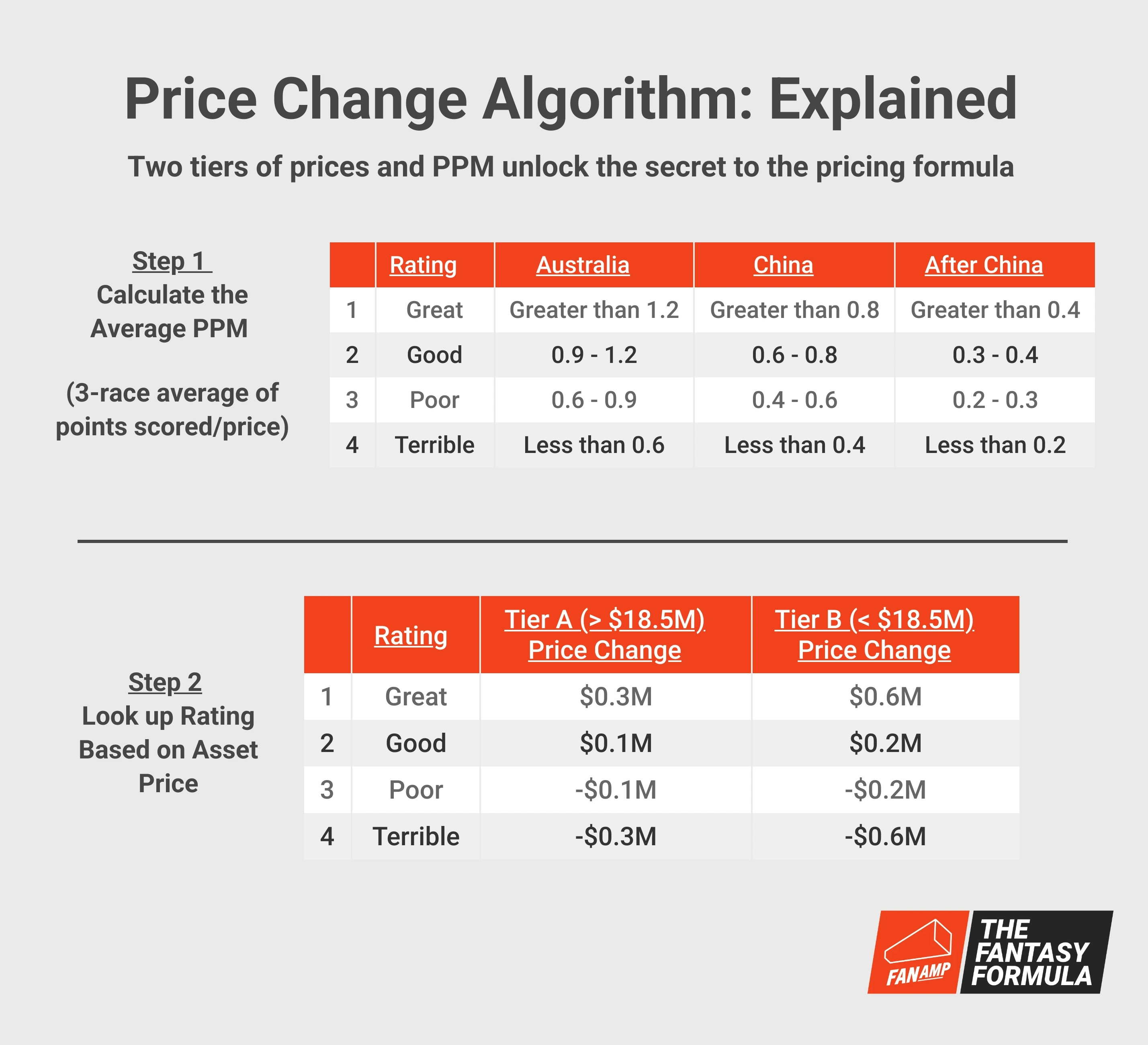
Points per Million (PPM) is determined by taking the score of an individual driver or constructor and dividing by their price - it helps to compare the relative value of every asset in the game. By calculating the average PPM over the previous three races, the results match to one of four performance ratings: great, good, poor, and terrible.
We can then take this performance rating and the price of the driver to determine the expected price change:
Calculating Australia and China Price Changes
If the game determines price changes based on the previous three races, how does it work for the first two races on the calendar? The game still uses a three-race average but makes the following assumptions:
- Race 1: An imaginary race where all assets scored 0 points
- Race 2: Another imaginary race where all assets scored 0 points
- Race 3: Australian GP prices, points, and PPM
Let's use Oscar Piastri at the 2025 Australian Grand Prix as an example: Oscar scored 10 points at his home circuit and entered the weekend at a price of $23.0M. His PPM for Australia can be calculated as 10 divided by 23, or 0.43. The game used 0 for the PPM of the "other two races", so the average of 0, 0, and 0.43 comes out to 0.14. Referring to the table above, an average PPM less than 0.2 leads to a Terrible performance rating and a $0.3M loss for a Tier A asset.
In China, the PPM thresholds for the various performance ratings decrease to 0.4, 0.6, and 0.8, however the PPM average consisted of 1 imaginary race, the result from Australia, and the result from China. Starting with race #3 in Japan, the PPM thresholds decrease one final time to 0.2, 0.3, and 0.4, where they remain for the rest of the season.
Using Previous Races to Predict Value Increases
The price change model weighs the last three races equally, which means that two-thirds of the price change has already been determined by previous races while just one-third depends on the upcoming Grand Prix weekend. This allows strategists to predict upcoming price changes and bring assets with impending price increases into their lineups.
In 2025, F1 Fantasy Tools launched the Budget Builder, a tool that displays the minimum number of points every driver and constructor must score to achieve each of the four price change outcomes. In the example below, McLaren will gain the maximum $0.3M if they score more than -61 points in the upcoming weekend — a lock unless both drivers face disqualification.

By using tools like these, we can consistently build our cost caps to afford powerful lineups in the second half of the season.
Be sure to check out our F1 Fantasy guides for details on how to use the six powerup chips, how to grow your team budget, and much more. You can also watch The Fantasy Formula on the official FanAmp YouTube channel every race week for detailed lineup advice, exclusive interviews, and a breakdown of the latest news.
Follow @FanAmpFantasyHQ on X, Instagram, Threads, and TikTok for daily tips, lineup advice, and exclusive interviews all season long 🏁
.jpg)




%20(1).jpg)

.png)
.png)