





Today in Betting 101, we are explaining the most common types of bets you can make, mixing some football examples in with our typical motorsports content since not all of these bet types are common in motorsports. There are plenty of options—including moneylines, spreads, and over/unders—so let’s discuss what each of them mean.


Moneyline Bets: The Simpliest Wager
Moneyline bets are very simple, so let’s start there. When you place a moneyline wager, you are betting on that team or driver to beat their opponent(s). In a football game, you are betting on that team to win the game. In motorsport, this type of bet may be called a head-to-head wager. All your driver has to do is beat the other driver and you win your bet.
This might sound like an easy way to make money over the long run. Bet on the favorite to win, they usually win, and we make bank, right? Well, it’s not quite that easy. In our previous article, we talked about how betting odds work, and how you have to bet X amount in order to win Y amount. Betting a moneyline will always include odds, and favorites have steeper odds than underdogs, meaning you will need to bet much more to win the same amount. For instance, a favorite will always have a minus sign in front of their odds. The larger the negative, the steeper the odds. A bet at -500 odds (bet $500 to win $100) has steeper odds than a bet at -200 odds. Underdogs always have a plus sign in front of their odds. Interpreting these odds, a +200 bet means you bet $100 to win $200.
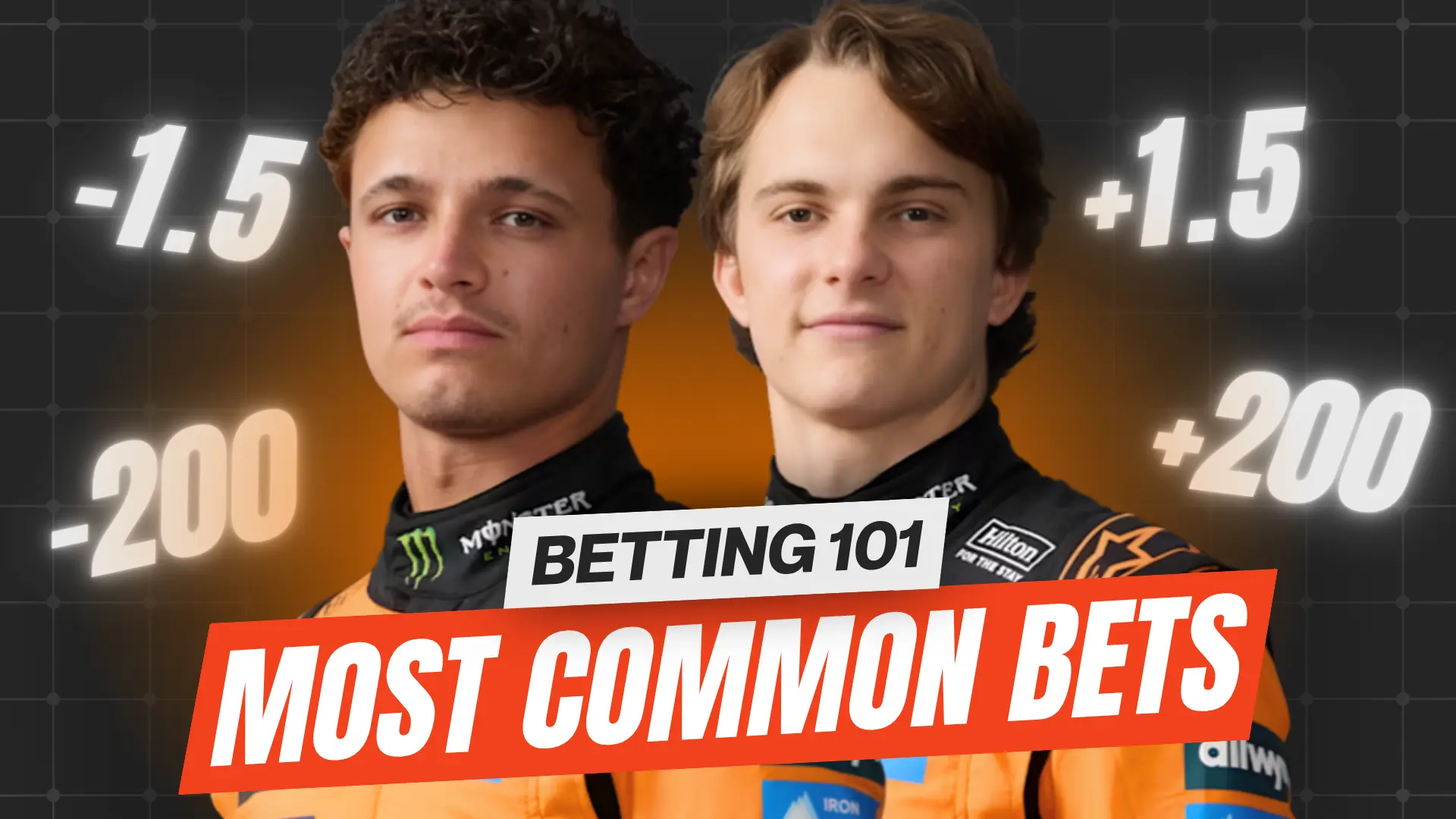
Speaking in motorsports terms, let’s use Formula 1 to make a hypothetical wager on Lando Norris to beat his teammate, Oscar Piastri, in a race. This would be a moneyline (or head-to-head) bet where each driver has different odds based on their likelihood to win the bet. Let’s say Lando qualified slightly ahead of Oscar, so he is favored to beat his teammate. If there’s a ~67% chance that Lando wins, his odds will be roughly -200. This means you need to bet $200 in order to win $100. Lando will win that bet about ⅔ of the time, and lose about ⅓ of the time. Adversely, Oscar's odds to beat Lando would be about +200. In this case, betting $100 on the underdog would pay out $200.
More on betting strategy in future editions of Betting 101.
Betting the Spread: The Most Common Wager
The most common type of bet in sports is called a spread. The spread is called “the great equalizer” in sports betting, because it typically means each team has a 50/50 chance to win the bet, even when one side is much better than the other.
Let’s use football as an example, and then I will bring it back to race cars. My beloved Green Bay Packers (GB) are far superior to the Chicago Bears (CHI). In this fictional matchup between these historic teams, the Packers are much better than the Bears and have a much better chance to win the game. This is where the spread is introduced. The Packers are seven point favorites, meaning the sportsbooks think the Packers will win the game by about 7 points. GB being favored by seven points can be expressed by saying they are -7. The -7 means you take 7 points away from the Packers at the end of the game and use that result to see if you won your bet.
If the final score is GB 24 CHI 21, the Packers won the game, but the Bears covered the spread. “Covered” means that the team has won the spread bet. The Packers were favored by 7 points, but only won the game by 3 points, so they failed to cover the spread. In this case, a bet on the Bears spread +7 is a winner, and a bet on the Packers spread -7 is a loser.
If the Packers won 31-21, they would have covered the spread, meaning they won by more than seven points. In this instance, the Packers covered the spread and spread bets on the Packers -7 would be considered winners, while any spread bets on the Bears +7 would be considered losers.
In the rare case that the game finishes with GB winning by exactly 7 points, that is called a “push” or a tie. In the case of a push, all bets are “no action,” meaning your bet is fully refunded with no winnings or losses.
Interpreting the Spread: What do the + and - Mean?
When you see a spread number with a minus sign in front of it, that team is favored to win. When you see a plus sign in front of the spread, that team is the underdog. The favorite and underdog will use the same number on their spread, so GB would be -7 and CHI would be +7. I know it's tricky to understand the minus means favorite and the plus means underdog. You’d think the positive sign would be connected to the better team, but that’s not the case in sports betting.
The spread is used most often in team sports, such as football and basketball. It is used less often in motorsport. If it were to be used in motorsport, it would look something like the following example with the McLaren F1 drivers. If Lando Norris is favored to place higher than his teammate, Oscar Piastri, Lando may have a spread of -1.5 places against Oscar. In this case, if you bet on Lando, you will need him to beat Oscar by 2 places or more to win your bet. If you bet on Oscar at +1.5 places, you need him to stay within 2 places of Lando to win your bet. There is no way to “push” this bet since it’s impossible to finish 1.5 places behind someone. Sometimes sportsbooks use half numbers in order to guarantee a winner and a loser.
Spread bets usually have odds of -110 on both sides, which means you need to bet $110 to win $100. In our example, the odds of Lando beating Oscar straight up (or a moneyline bet) are -200, but the odds of Lando beating Oscar by 1.5 places are -110. The moneyline bet is more likely to win, but the payout is worse. The spread bet is less likely to win, but the payout is better. Making the best decision based on your affinity for risk is what makes sports betting so tricky.
Over/Under or Total: The Offense of Defense Bet
The last type of bet that we will discuss today is the over/under, which may also be known as the total. This is the total number of points scored by both teams in a contest. A total is very common in team sports such as football, basketball, and baseball. These bets are not very common in motorsports. The one case where I’ve seen an over/under in motorsports is the number of classified drivers at the end of the race. This is a bet where we predict how many drivers will complete the race. In an F1 race, this number may be around 18.5 classified drivers. If we think there will be a lot of DNFs, we should bet under 18.5 drivers, and the opposite if we think it will be a very clean race with good reliability.
Let’s shift to American football, where this type of bet is much more common. If there is a contest between two defensive teams, the total will be a lower number. If both teams have strong offenses, the total will be a higher number. In NFL football games, a lot of the totals are in the 40’s. In college football, where offense is typically stronger than defense, the totals can be much higher—in the 50’s or 60’s.
Let’s go back to our GB/CHI football game where GB is -7. The spread tells us who is favored to win the game and by how much. But the spread does not account for the total number of points scored in that contest. Let’s say the total for the GB/CHI game is 42.5 points. If you bet the “under,” you will win your bet if the combined score is under 42.5. If you bet the “over,” you will win if the combined score goes over 42.5. If we use the score of GB 24 CHI 21, this game went “over” the total of 42.5 since 24+21=45.
Odds on total bets are typically -110 on both sides, much like spreads. Betting $110 to win $100 requires a winning percentage of 53% to start turning a profit. This is how sportsbooks make money over the long haul. They post a handful of 50/50 bets and profit on customers who fail to reach a 53% win percentage. Sportsbooks will also ban highly skilled individuals who regularly win 55% or more of their bets, but that is a story for a different day.


.jpg)




%20(1).jpg)
.png)
.png)