



When one door closes, another one opens... You just have to be prepared to jump through it.
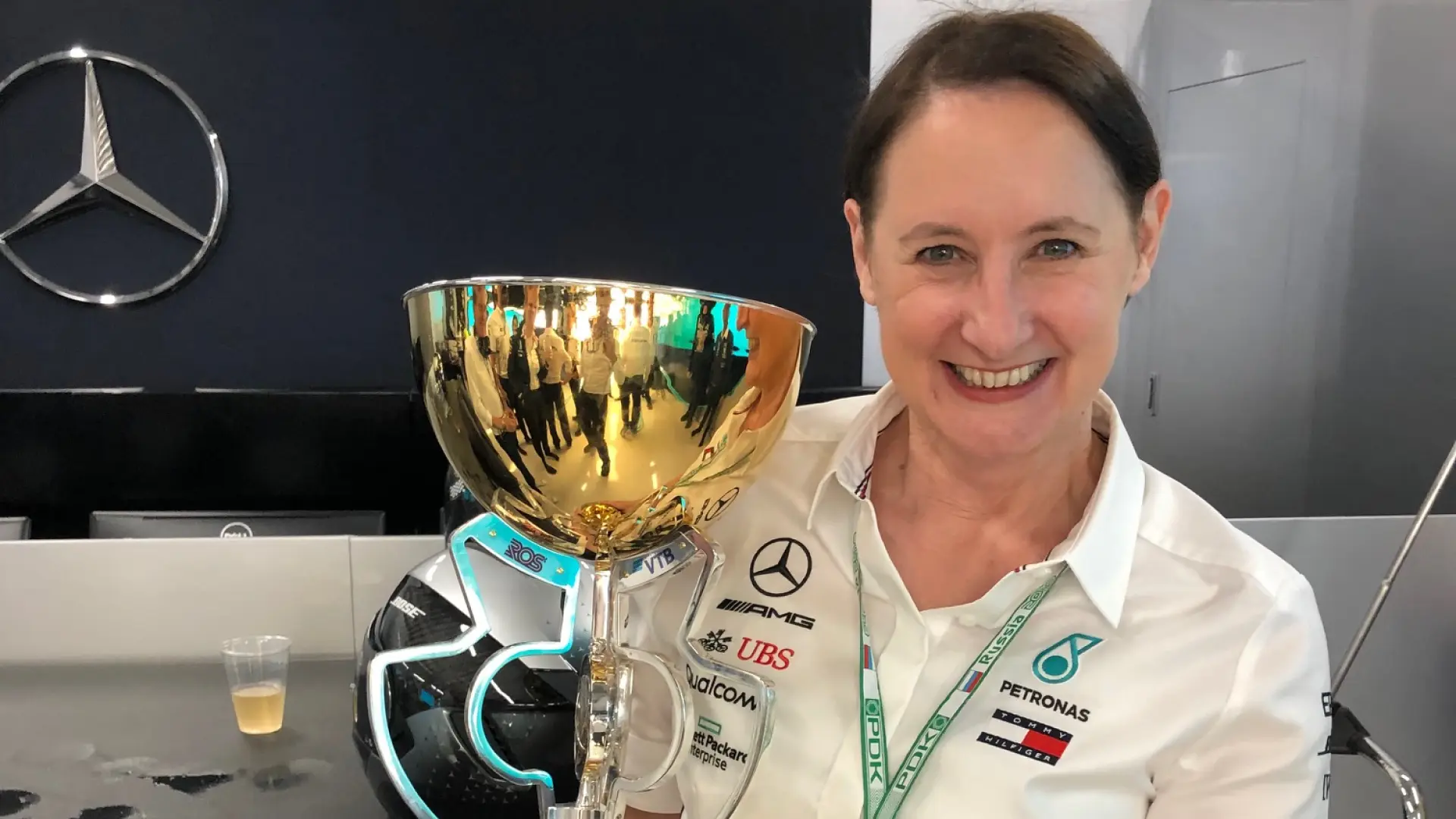
This was especially true for Nicole Bearne. Who would have thought answering a classified ad between jobs would spark an incredible journey from the British embassy to nine F1 Constructors' Titles with Brawn GP and Mercedes? The Comms Exchange founder shares how she made the most of being in the right place at the right time, and why communication is key even when you're on the winning team.
Position: Founder and Director at The Comms Exchange Ltd
Day to day: I try to help companies to build that sort of happy, high-performance environment where people can bring their best selves to work and deliver the best possible results through better communication.


Nicole’s start in motorsports
#1. What was the first moment that you discovered racing?
I didn't really focus much on racing as a kid because I didn't come from a racing family. We didn't have it on in the background. But I do remember my dad, when I was little, watching the Formula 1 races on TV on Sundays, and so I was very aware of who all the different racing drivers were. And I would sit and watch with him. I think he used to bribe my sister and I with chocolate to keep us quiet, so we would always enjoy our Formula 1 races on a Sunday afternoon. I remember watching the James Hunt and Niki Lauda battle in ‘76 and being a fan of Nigel Mansell; following the British drivers as a teenager. But back in those days, it was just something you watched on television. It wasn't something that I thought about as a career or that I thought I could go and do in some way. I wasn't going to be a racing driver. It was a general awareness, and I followed the sport.
#2. You started in oil and aluminum trading. How did you end up pursuing motorsports as a career?
When I was at school, I just wanted to get out and see the world, and I wanted to travel. And so, my ambition when I was at school was to be a diplomat. I went to university and I studied Russian and linguistics and international relations. And my first job straight out of university was actually at the British embassy in Moscow. And I spent four years out there working across a number of different organizations in Russia. And when I came back to the UK in ‘94, I got a job working for a Russian oil trading company in London. And I worked with them for a couple of years supporting the chairman and president of the company, and then also doing some of the oil trading operations. And from that I then moved into aluminum trading and spent a couple of years working with the Metals Trading Company, which was a joint venture between a Swiss company and a Russian company, managing their London operation, their London office as well. So, my route had been Russian language, and working with Russian organizations, Russian companies, until I stumbled over motor racing again.
Greg: And how did you make that switch to racing?
It was a really strange thing. I was working as executive assistant to the president of the Russian oil company, who's a very wealthy Russian. We spent quite a lot of time flying backwards and forwards to Moscow on private jets. And all his shopping came from Harrods and all that kind of thing. He was very wealthy. It was a good learning experience for Formula 1.
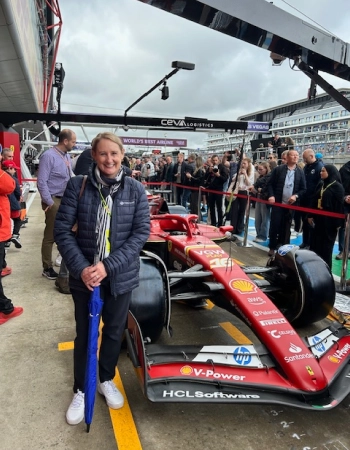
But anyway, one day he basically said to me that he wanted to take a group of his business colleagues, business customers, and clients to the British Grand Prix. And in kind of his usual style, it was no expense spared. We want the absolute premium VIP experience. So, I organized a whole trip for them where we flew in on helicopters into Silverstone and they had the best seats on the start finish straight to watch the race and they had the best hospitality and that was in ‘94. I watched Damon Hill win the British Grand Prix which was a very popular win. And just thought,
“Wow, this sport is amazing!”
Having had that experience, and been able to go and see the race in person I thought, this is fantastic. I need to come back and watch more racing. And so that's how I got back into following the sport, but very much as a fan.
Four years later. I was working for this joint venture, the Swiss and the Russians, and they basically decided that they were going to close their partnership; they closed their London office, and I got made redundant. It was right at the end of ‘97, I gave myself the Christmas off, and then thought, ‘98, I will get the newspaper, as you did in those days, and look for another job. In the meantime, over the few years that had followed after seeing the British Grand Prix for the first time, I had started becoming a real fan. I subscribed to the Autosport and Motor Sport magazines. I went to the British Grand Prix every year to see the racing, and I just became a real fan of the sport. So, I was very aware of what was happening in the sport at the time, and who the different teams were, and the different individuals involved.
And so the January after the Christmas where I got made redundant, I got the newspaper, the London Evening Standard newspaper, and I turned to the back where they had all the job advertisements, and staring out at me was an advertisement looking for a personal assistant to the team principal of a brand new Formula 1 team that was in the process of being set up called British American Racing. And I just thought, ‘This is fate. This is my job.’ And so I applied for it, and a couple of months later, I heard I'd got the job. So, that's how I got my first break in Formula 1.
Nicole’s current role
#3. When you think about your role and where you fit within this world over the past 15 years of your career, what have you really been focused on?
The Comms Exchange grew out of my role as Head of Internal Communications for Mercedes Formula 1 Team, and it's very much based on the idea that communication is integral to performance. And in fact, we know that it is actually the most important, the key factor for organizational performance, and how well organizations communicate will support their overall performance.
Alongside that, we also know that communication can drive what we call employee experience; how an individual, working in an organization, experiences that organization on a day-to-day basis, and how it can make somebody's work more enjoyable, and motivate them to continue to bring their best selves to work every day. It's also vital in organizations which we live with nowadays, which are changing rapidly. And that we draw upon the fact that within Formula 1, nothing stays the same, everything constantly changes.
That's where the Comms Exchange comes from, and the name of the company sits within that, is communication, experience, and change. And that's what we work on. What I set the company up to do is to try to help companies to build that sort of happy, high-performance environment where people can bring their best selves to work and deliver the best possible results through better communication. And that's what I'm focused on. That means designing and implementing communication strategies that will help to build performance, build employee engagement, create a real strong team mentality. To do that, I draw upon my experience within Formula 1, and how we do that in motor racing.
#4. What are some of the more rewarding and challenging aspects of being able to facilitate good communication?
Rewarding
In terms of my role and the work that I do, I absolutely love working with people. And effectively, teams are people, and leaders are people. I get a lot of energy and a lot of enjoyment from just those sort of interactions with people, helping them to think about the way they communicate, whether that's a leader personally communicating with his or her team, up to individuals who are building new teams, to disperse teams around the world where they don't even ever meet each other, how they can build that strong sense of team-ship, of what it means to be part of something. That gives me the opportunity to work with an incredibly diverse group of clever and talented people quite a lot of the time so that’s great.
Challenging
The challenges with that are the same challenges that everybody experiences. The speed of change can be quite challenging. Client briefs can change quite a lot from the time that you start working with them to the time that you actually come to implement some of the work. But it just keeps me on my toes. I'm used to working at speed. We're used to supporting organizations to think about, and challenge the way they think about things. And just being able to tap into some of my experience from Formula 1 to do that, I think has been rewarding.
#5. What qualities have helped you succeed in your career and your role now driving better communication and better performance?
Growth mindset
A growth mindset, definitely. I'm not one for resting on my laurels. I'm constantly looking to upskill, to learn more, to understand more, get more experience. I tend to go back to the classroom whenever I feel like I need some more knowledge or understanding. I go back and study a lot. That sense of continuous improvement, that you're always looking to try and improve, there's always that little even better moment in anything that you do. And the review process that you do; after I complete a project, I look back and think, “What could I have done differently? What could I do better next time?” So that definitely is something that I've taken from Formula 1 as well.
Attention to detail
Attention to detail. When you come from a comms role, you're constantly looking at the way that things are worded, making sure that the grammar's right and the spelling is correct and all of that sort of thing. And the same goes for anything that you do, is just making sure that you do it to the best of your ability.
Can-do mindset
I suppose the other thing is just having a can-do mindset. Nothing is impossible, you've just got to figure out how to do it. And again, I think some of that comes from 25 years in Formula 1; you never say “this is impossible, you can't do this or we can't do this.” It's just like, “Okay, let's sit down, break down the problem and figure out a way.” And that definitely helps me in my work today.
#6. You were in a position where you had a lot of firsts, a lot of big titles, but I'm sure there were definitely weekends that were not good on that journey. What did you find motivated people to keep pushing, even though it may not have felt good in that exact moment?
If you've got the right team mentality, you've got the right mindset. People see challenges like that as learning opportunities. And when you have a bad weekend, actually what you take away from it is the benefit of having that bad weekend, because it means you don't get complacent, because it means you don't start to rest on your laurels, and everybody in Formula 1, and in any competitive industry, knows that you can't afford to do that. Sometimes the bad weekends are a bit of a wake up call, and that's not a bad thing. We don't learn and grow from the good days. We don't take anything away from that. But all your real learning is in the tough times, in the hard times and the challenging days. And that was definitely something that we built the culture around in Formula 1 at Mercedes. And it was definitely something that Toto Wolff and Niki Lauda were very vocal about, and adamant about, we do our learning when we fail, and when we fail is the time to regroup, look at it and take a long, hard look at ourselves and say, “What do we do differently?” That is what keeps driving the team forward.
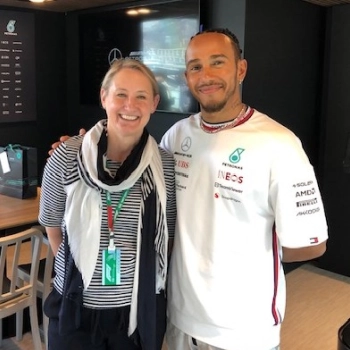
And when we had eight back-to-back World Championship wins, you know that you are working in and you are operating in a sport which everybody is pushing flat out. And if you don't continue to push flat out, then you won't even be lucky to get into the top five the following year because everybody will be behind you, snapping at your heels, waiting to try and make the most of any complacency that you have. So, it is just constant improvement, constant looking at long, hard look at whatever you're doing regardless, and saying “How does that get better?”
Greg: Do you take the same approach even on the weekends that are good where it's: “Okay, great. Nice job everyone, but let's take a look at what went well and how we learn from it”?
Absolutely. Most of our debriefs, even within the communications team at Mercedes, and the way I work today, is we always go, “Right. What went well? What could we do better?” Nothing's ever going to be perfect, but you want to be able to learn. You take the recognition of what went well. You do have to recognize when things have gone well. You can't ignore that. You do have to celebrate those moments where things went well, and we definitely took time to do that. But by the same token, there's always room for improvement for next time and learnings that you can take.
Nicole’s advice
#7. If you could go back and give your younger self advice before you started on this path, what would it be?
One of the things I always think back to when I think about my childhood is that I didn't have a lot of confidence in my own abilities. Definitely something was always on my school reports, needs to build confidence, and all this sort of thing. I think I would probably say “You are better than you think. You need to be more confident because you can succeed, and you can do what you set out to do.” So that's definitely one piece of advice I would give myself. The other thing I would probably say is “You're better at maths than you think” as well, because I was always convinced when I was at school that I was absolutely dreadful at math. So therefore I almost developed a phobia around numbers and therefore science as well. But now, in my late 50s, I'm fascinated by physics, space, and the universe. And I think I would love to have learned more about that in school. I think I probably would say, “Look, just spend more time, focus a little bit more on the maths and physics as well, because that's really cool stuff.”
Greg: Was there some moment that got you over that or is it just a continuous reminder for yourself?
It is continuous. And like the imposter syndrome. I still get that constantly. I do quite a lot of public speaking now. And whenever I'm asked to go and speak to an audience, I'm always panicking beforehand thinking, why on earth do they want to hear from me? There's definitely that element of never quite feeling that you have the capabilities that you do. But in the back of my mind, I've realized over the years that I've always been able to achieve the things that I've set out to achieve, whether that's been partly through luck, hard work, or being really focused. But I've achieved what I set out to do, and that has given me confidence now that if there's a new project I think, yes, I'm going to take on this new project. My experience is that I will achieve it, even though I may not be confident that I can.
Greg: Luck is just making good use of an opportunity.
That's one of the things that my old boss, Ross Brawn, always used to say. Luck is preparation waiting for opportunity. As long as you are prepared, and you've done your homework, and you've done the groundwork, when the opportunities come along, you'll be in a good place to pick up on those opportunities.
#8. What advice would you give to someone who's looking to be in your position?
I think it depends on where you're starting out in your career. If it's somebody who's right at the very start of their career then I would say, just look to build your contacts and build the network that you have around you. Places like LinkedIn are a great opportunity to see who works in the space that you want to move into, to see what they're writing about, to see what challenges they're facing. And to really immerse yourself in that environment or that culture. I get a lot of people writing to me saying, “How do I get a job in motorsport?” And my advice is always, “What is it that you want to do to start with?” Know what it is that you actually want to do, whether that's communications, marketing, engineering, aerodynamics; where does your interest, passion, strength lie, and then see who's in that space and see what they're saying, and see what they're writing about. And then try and get out there and give it a go at any kind of level, whether you're a young and up and coming engineer, and you want to get some experience in a motor racing team. Get yourself to races, talk to mechanics, not Formula 1 because that's always too tough to get close to any of the teams, but grassroots motor racing that takes place at your local circuit weekend after weekend. Talking to mechanics, talking to engineers, meeting people, hanging out in the pit lane if you can, on the paddock, volunteering, offering to help in any way you can—just gives you that network and those connections, and then you never know what may come of that.
Nicole’s career highlights
#9. What was the most memorable communication you had to send, whether it was something that was really challenged within the organization or something really positive that you were celebrating?
I would say it's not necessarily the communications that I was sending that are the most memorable moments. I think they were the moments where we created something that left a lasting impression on every single member of the team. And a lot of the time, those were moments of celebration.
So, if I look back, one of the moments that is almost one of the highlights of my career was when Brawn GP won the World Championship in 2009. And that was our first World Championship win as a team. And the day after the race weekend, Ross [Brawn], my boss at the time, was coming back to the factory and I sent out an email to the whole team to say, look, Ross’s ETA at the factory is whatever time, it would be great if we could all head out and just welcome him back in. We had quite a long driveway from the main gate up to the reception area, and at the allocated time, the whole team came out onto the roadway and as Ross drove in with the car, the whole team was applauding and celebrating his return to the factory and our championship win. And it was a massively emotionally charged moment, both for him and for me and everybody else in the team, because it was unscripted and it was impromptu, but it was a really lovely tribute to the man who'd got us into that place where we were able to still be existing as a team, and to then win a World Championship out of nowhere. Those little moments of team connection where everybody came together to either celebrate or to support each other, those were the communication moments that meant the most over the years.
#10. Who's your dream client to work for now?
I'd work with anybody because every company is incredibly fascinating. I have an organizational behavior approach; I like to look at how companies work. And each one is unique and different. I don't think there's one particularly; NASA I would absolutely die to work for because space is so cool. But I love working with teams. I love working with Formula 1.
Spending time connecting with the motor racing world, I'm incredibly fortunate at the moment because I'm also a non-executive director for Motorsport UK which is the governing body and membership organization for motor racing in this country. And so being a board member with them, I also get involved with how grassroots motor racing happens in this country. How we support people to get involved in motor racing, whether that's as competitors or volunteers or officials, and keep racing safe, accessible, fair and fun for everybody. So that's brilliant as well, because although I don't get paid for that role, it means that I get to spend weekends at race tracks watching motor racing in all its different forms.
Want to learn more about other professionals across motorsport series? Then check out all of our Fast Lane interviews, or jump right into one of these:

.jpg)

.png)
.png)