




The Wildcard chip returns to F1 Fantasy to give players unlimited transfers before lineups lock. Since exceeding the free transfer limit results in a 10-point penalty per transfer, this chip helps you make big changes to your lineup without taking transfer penalties. In this guide, we'll review how Wildcard works, recommendations on when to play it, and walk through an example of the chip in action from the 2025 season.


What is Wildcard?
Like the other chips in the game, Wildcard is only available once per season. This chip unlocks after a team has completed one race weekend. Normally, the game provides two free transfers per race and players may carry up to one unused transfer to the next race for a maximum of three free transfers. Once all free transfers have been used, each substitution triggers a 10-point penalty. Wildcard grants players unlimited free transfers until the lineup lock deadline.
When is the best time to use Wildcard?
Many teams use Wildcard on the second or third race weekend as they realize their lineup from the season opener missed the mark and they need to course correct quickly. Of the Global League Top 500 last season, 26.2% used Wildcard in Round 2 at the Chinese Grand Prix following a chaotic race in Australia that resulted in six DNFs.
A common question is "when should I use Wildcard instead of taking a transfer penalty?". As a general rule of thumb:
- Races 1–18:
Use Wildcard to prevent 2 or more transfer penalties (-20 points) - Final 6 races:
Use Wildcard to avoid any transfer penalties at all
How Wildcard works in F1 Fantasy — Example Scenario
After selecting the Wildcard chip, players can make unlimited transfers as indicated by the infinity symbol under Free Transfers:

Once selected, the Wildcard logo will appear at the top of the lineup page (a pair of up and down arrows):

Wildcard in Action: Case Studies from Top Teams
In 2025, the second place team in the world used Wildcard between the first and second races of the season. This team, 44th Gear, suffered two DNFs in the season opener while the Ferrari drivers finished P8 and P10 - he needed to make several moves to correct his lineup prior to the first Sprint race in China
44th Gear used Wildcard to shake up his team, switching his constructor pairing to McLaren and Williams, and removing the two rookies that would lose value as a result of their DNF in the previous race. In all, this team made four transfers and prevented 20 points worth of transfer penalties.
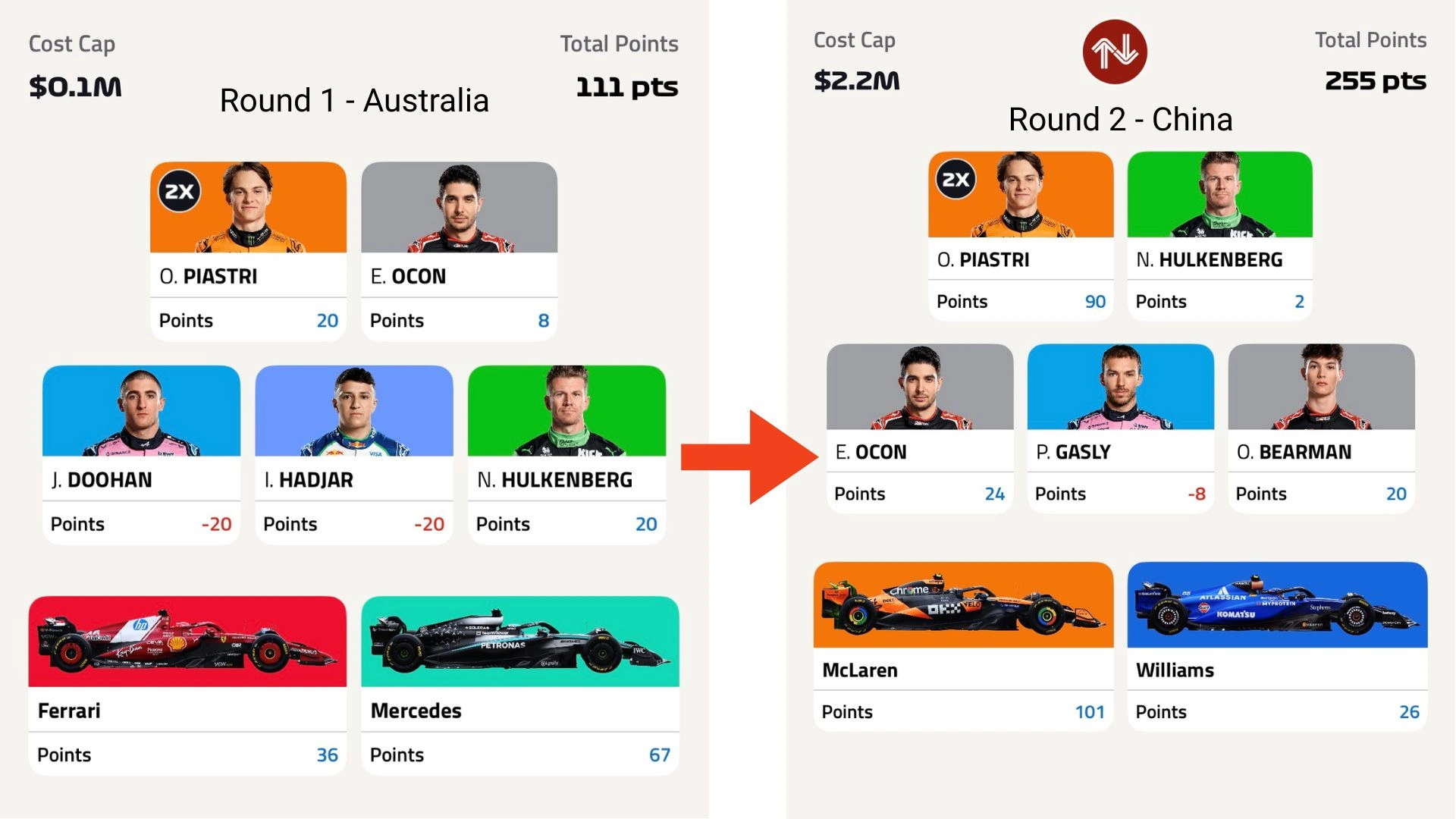
By contrast, the Global League Winner used Wildcard to pivot out of a unique differential later in the season. For the Dutch Grand Prix, many teams flocked to a triple McLaren and Aston Martin lineup. Prior to the Italian Grand Prix, Ferrari appeared in top form as well as the Williams duo of Carlos Sainz and Alex Albon. This team, Most Points Possible, used Wildcard to make four transfers and prevent 20 points worth of transfer penalties to return their lineup to its long-term structure.
.webp)
A quick word about free transfers
Some players may carry an unused free transfer into a future weekend, increasing their free transfer maximum from two to three. If a team has three free transfers and uses Wildcard, they will lose the third free transfer and drop down to two for the following race.
Be sure to check out our F1 Fantasy Guides for details on how to use all of these power-ups, how to grow your team budget, and much more. You can also watch The Fantasy Formula on the official FanAmp YouTube channel every race week for detailed lineup advice, exclusive interviews, and a breakdown of the latest news.



.webp)

.webp)


.png)
.png)